Download Novartis Case Study
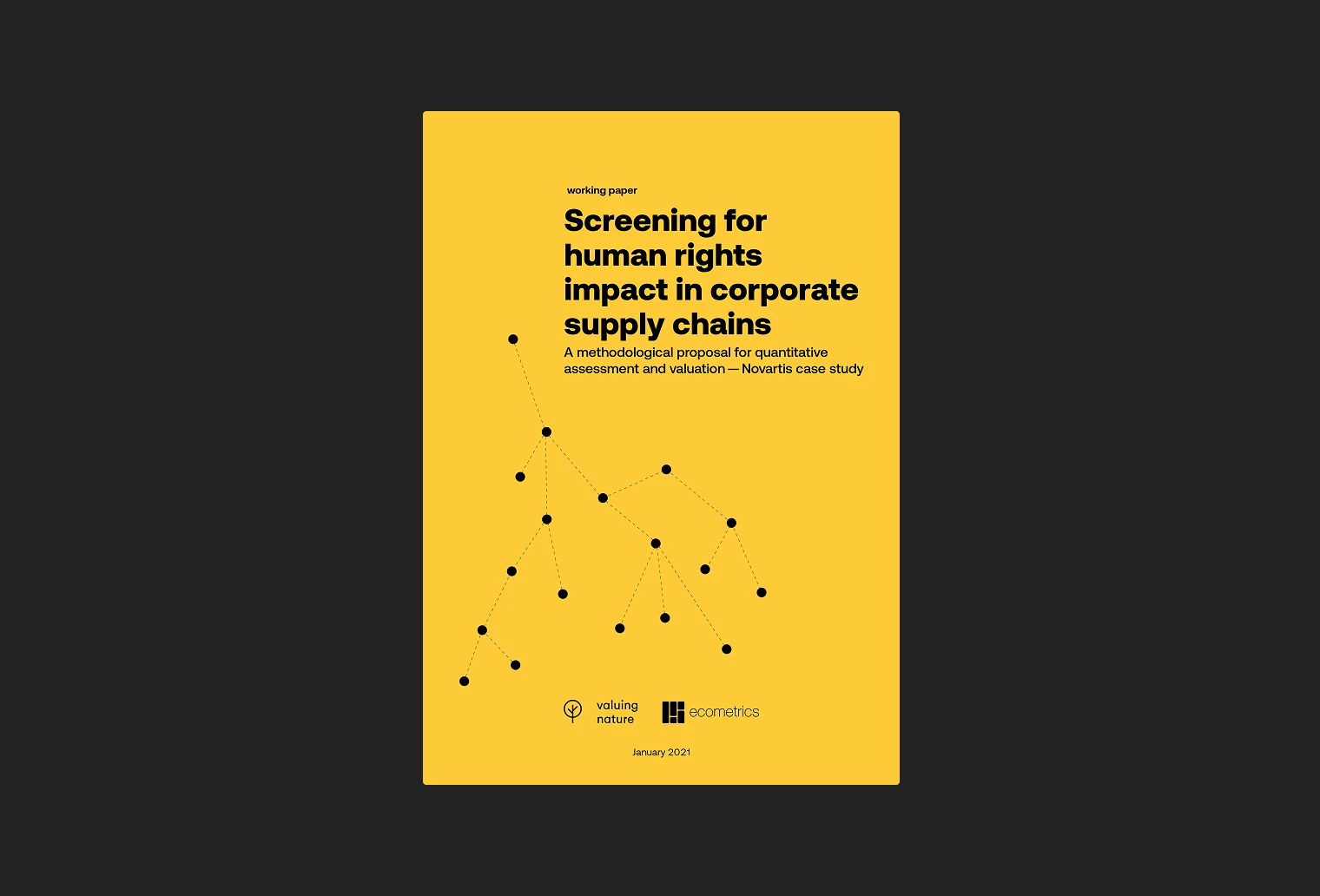
A methodological proposal for quantitative assessment and valuation.
Introduction
The private sector is increasingly under pressure to address human and labor rights issues worldwide1, not only in their operations but also in their supply chains. Companies with complex supply chains are facing operational and reputational risks as a consequence of economic globalisation. However, companies’ visibility of their supply chain is limited, very often to a selected few direct suppliers which limits the capacity stakeholders, including the companies themselves, to take action and address those risks and impacts. Reducing risks and creating social value, aligned with the SDGs, is key to long term value creation.
Despite past efforts around transparency, selection and knowledge of suppliers, issues such as child labor, forced labor, corruption, living wage, working poor, and so on, are still very present in many regions of the world connected to the global economy.
Several reasons can be listed for these lack of actions, among which, the absence of adequate tools for screening human and social capital risks over entire supply chains and prioritization. A series of approaches do already exist (including supplier audits, partnerships with NGOs and research institutes or consulting services providing prioritization maps, etc.), but does not provide a granular, transparent and comprehensive enough view.
We identified three main limitations of current approaches:
- First, companies mostly rely on generic external data not connected to their own activities, or purchasing patterns (e.g. a generic map of countries showing high risks of child labour) rather than on data connected to their activities (e.g. considering the size of their activities in a particularly risky sector in a specific country).
- Second, the underlying data used in these assessments usually considers issues from a limited viewpoint, for instance sectorial or geographical coverage, while both are needed to understand where to act. Additionally, when single issues (e.g. child labor) are considered in isolation to overall human rights issues, it greatly limits the capacity to generate valuable insights.
- Third, the supply chains beyond the first tier are rarely considered because of a lack of information on how they are constituted.
In this paper, we present a methodology to assess the human and social capital risks (in particular the human and labor rights issues) in the operations and supply chain of a company in order to go beyond these limitations. This approach is based on economic and human right statistics, as real data on labor/human risks is extremely difficult to collect for a large company, with potential blocking points to obtain traceability on goods and services. Using the large amount of public data currently available and modern quantitative methods enables us to bring valuable insights to companies for addressing human and social risks in their supply chain, and refining their sustainability strategy.