How an impact valuation across five deployment scenarios turned a promising climate technology into a market prioritisation strategy, and what it tells us about the future of due diligence.
The cooling paradox
The world’s response to a hotter planet has been to install more air conditioning. Space cooling demand has tripled since 1990 and could triple again by 2050, with 5.6 billion AC units projected by mid-century. The HFC refrigerants inside those units carry a global warming potential up to 2,000 times that of CO₂, and unabated leakage alone could add 0.5°C of warming by 2100. At the same time, an estimated 2 to 4 billion people in the Global South have no access to adequate cooling at all.
The technology meant to protect people from heat is accelerating the heat itself, and leaving the most exposed populations behind. This is the cooling paradox, and it is the problem that Temperate, a radiative cooling company backed by Adapt[us] Capital, is trying to solve. Temperate’s technology passively rejects heat to the cold of space, using roughly 5% of the electricity of a conventional split AC and zero refrigerant gases. The proposition sounds compelling on paper. The harder question, and the one investors actually need answered, is where it creates real societal value, where it does not, and how to allocate capital accordingly.
Valuing Impact ran a full impact valuation of Temperate’s technology across five deployment scenarios using the eQALY methodology and the VI Platform. The results show why context matters more than technology in climate adaptation.
What the analysis covered
Each scenario modelled a standardised deployment of 1,000 Temperate units in a specific geography and market segment, with location-specific assumptions for grid intensity, electricity tariffs, cooling season length, and the counterfactual technology being displaced. Five scenarios were chosen to span the full strategic space, including AC replacement and first-time access, growth and stable economies, and residential and commercial settings. The analysis quantified value across human, social, and natural capital in a single monetary framework, allowing direct comparison between health benefits, household savings, and avoided emissions.
The two strongest cases turned out to be very different from each other.
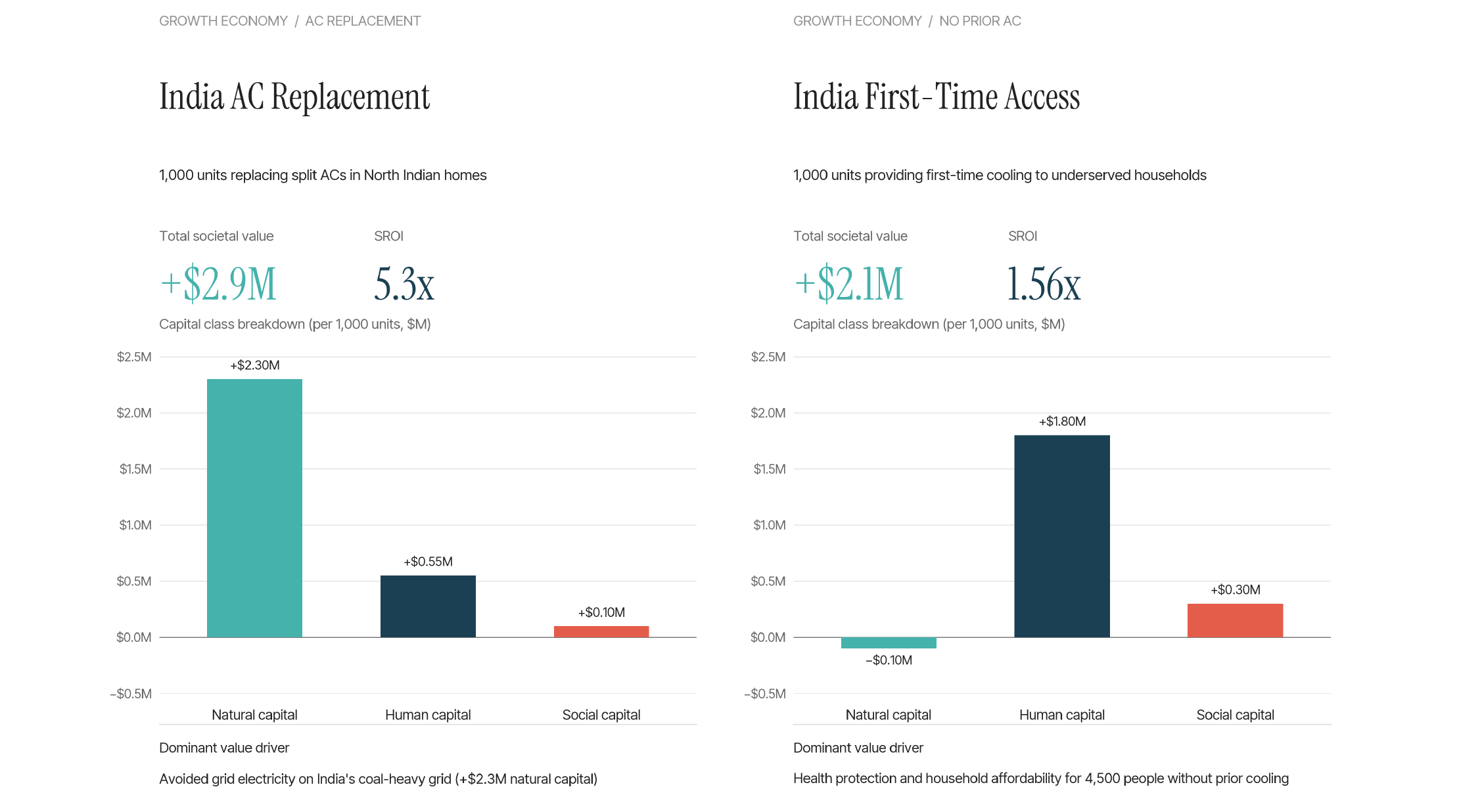
In the India AC Replacement scenario, Temperate generates +$2.9M in societal value per 1,000 units and an SROI of 5.3, almost entirely driven by avoided electricity on India’s coal-heavy grid and eliminated refrigerant releases. Natural capital does the heavy lifting because the counterfactual is so polluting. In the India First-Time Access scenario, the technology delivers cooling to households that previously had none. Natural capital turns slightly negative because no AC is being displaced, however human capital surges to +$1.8M through health protection, survivability, and household affordability for roughly 4,500 people. Total societal value lands at +$2.1M with an SROI of 1.56, making this the strongest equity case in the portfolio.
These are not the same business, and they should be addressed differently in terms of business strategy and capital allocation.
The full picture across five scenarios
The pattern becomes clearer when all five scenarios are placed side by side. The counterfactual, meaning what Temperate replaces or supplements, determines which capital class dominates. Climate context, meaning how much cooling is actually needed each year, determines whether the case stands up at all.
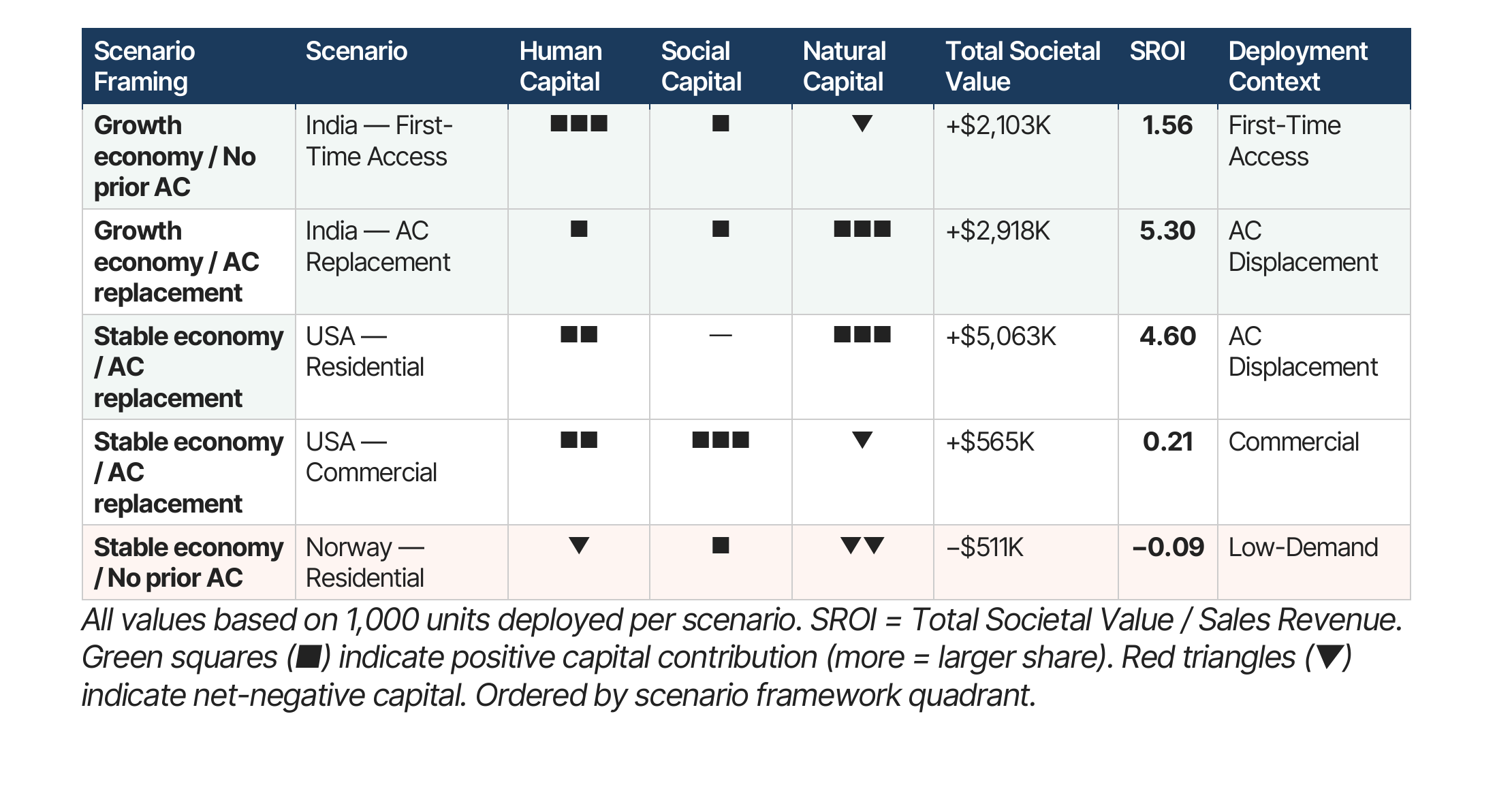
Three findings stand out from this matrix.
First, displacement of conventional AC in high-cooling-demand markets is consistently the strongest commercial and societal case. The India AC Replacement and USA Residential scenarios both deliver SROIs above 4.5, with avoided grid electricity and refrigerant elimination accounting for the bulk of the value. India and the US South are the priority geographies, and India alone accounts for roughly 70% of modelled human capital value across the portfolio.
Second, first-time cooling access creates a fundamentally different value proposition. The human capital story is large enough to carry the case on its own, however it requires a separate go-to-market track aimed at impact investors and development finance, not the same buyers as commercial deployment. Mixing the two would blur the unit economics and weaken both narratives.
Third, low-demand contexts should be excluded from go-to-market strategy. The Norway Residential scenario produces net-negative societal value of −$511K because embodied hardware costs and supply-chain impacts outweigh the marginal comfort benefit when cooling is only used for 10 to 20 days per year. Temperate is a high-utilisation technology, and the impact case collapses without sustained runtime. The same logic applies to other temperate-climate or stable-economy markets with limited cooling days.
The US Commercial scenario sits in the middle, with a modestly positive +$565K driven by tax contributions and productivity gains, partially offset by occupant nuisance from noise and drafts. It works, however the margin is thin, and value depends heavily on sustained high-occupancy demand.
Why methodology design mattered here
Cooling technology is unusually difficult to assess because its benefits cut across three forms of capital. Energy savings, refrigerant elimination, health protection, household affordability, and grid resilience normally get measured in different studies, by different teams, using different units. A standard carbon footprint would have caught the avoided emissions and missed everything else.
The eQALY framework translates outcomes across human, social, and natural capital into a common monetary unit, which is what makes side-by-side scenario comparison possible. In the India AC Replacement deep dive, the model decomposes 22 distinct impact pathways across own operations, supply chain, products and services, and end of life, with each pathway carrying explicit baseline, attribution, and drop-off adjustments. The single largest pathway, avoided grid electricity, generates +$2.32M in natural capital and is itself broken down across 18 ReCiPe 2016 midpoint categories, including air pollution at $794K, climate change at $580K, resource depletion at $424K, and land use at $324K. This decomposition is what allows the analysis to pinpoint exactly which assumptions drive the result, and where future field validation should focus.
The headline finding from that deep dive is that 98% of positive societal value depends on a single performance claim, specifically that Temperate draws 5% of the electricity of a split AC. That claim has not yet been independently field-validated. If real-world performance lands at 15 to 20% instead, the SROI falls from 5.3 to roughly 1.5 to 2.0. Identifying that dependency is more useful to Adapt[us] Capital than the headline number itself, because it tells them where to invest in evidence next.
What the VI Platform makes possible
This kind of analysis used to take months and a small consulting team. The five-scenario comparison, the 22-pathway decomposition, the regionalised value factors for India, Norway, and the US, the ecoinvent-backed environmental modelling, and the sensitivity analysis on every key parameter would normally have meant a six-figure engagement and a calendar quarter of work.
The VI Platform compresses that into something investors can actually use during due diligence. The platform operationalises the eQALY methodology through an agentic AI pipeline that automates company information gathering, value chain mapping, theory of change development, impact valuation, and coherence checks across multiple specialised agents. It draws on built-in databases for carbon accounting, lifecycle assessment with ecoinvent decomposition, input-output analysis, and regionalised value factors, so results reflect local grid intensity, tariff structures, and labour conditions rather than global averages.
For the Temperate analysis, that meant modelling five geographies side by side with consistent methodology, decomposing each scenario down to pathway level, and producing a fully traceable audit trail where every data point and assumption can be inspected and challenged. The same capability scales to portfolios of 100+ assets, which is what makes the platform useful for impact investors, PE funds, family offices, and foundations integrating impact intelligence into screening and portfolio management.
What this means for climate adaptation investing
Temperate is not one product with one value proposition. It is a platform technology whose impact and commercial potential vary dramatically by deployment context. The same holds for most climate adaptation technologies, including water systems, food logistics, resilient housing, and grid infrastructure. They all create concentrated value in the right context and destroy value in the wrong one.
Generic impact claims do not survive contact with this kind of analysis, and they should not. Investors backing climate adaptation need the ability to distinguish between markets where the case stacks up and markets where it does not, before capital is committed rather than after. That is what evidence-based impact valuation is for, and it is what the VI Platform was built to deliver at portfolio scale.
The full report, including the methodology appendix and the India AC Replacement deep dive with all 22 pathways, is available for download below.
Prepared by Adapt[us] Capital, Temperate, and Valuing Impact. April 2026.