Download the Impact Statement Framework publication
The gap in sustainability reporting
Organizations today face growing pressure to demonstrate their value to society. Investors integrate impact into allocation decisions. Regulators introduce mandatory sustainability disclosures.
Customers and employees demand transparency. Yet most sustainability reporting still delivers disconnected metrics — tonnes here, percentages there, headcounts elsewhere — that cannot be compared, ranked, or translated into strategy.
The result? Decision-makers are left with fragmented data that sits on the shelf rather than driving action. What’s been missing is a tool that does for societal value what the financial P&L does for economic value: put everything on one page, in one unit, so leaders can see the full picture and act on it.
That’s what the Impact Statement is designed to do.
What is an Impact Statement?
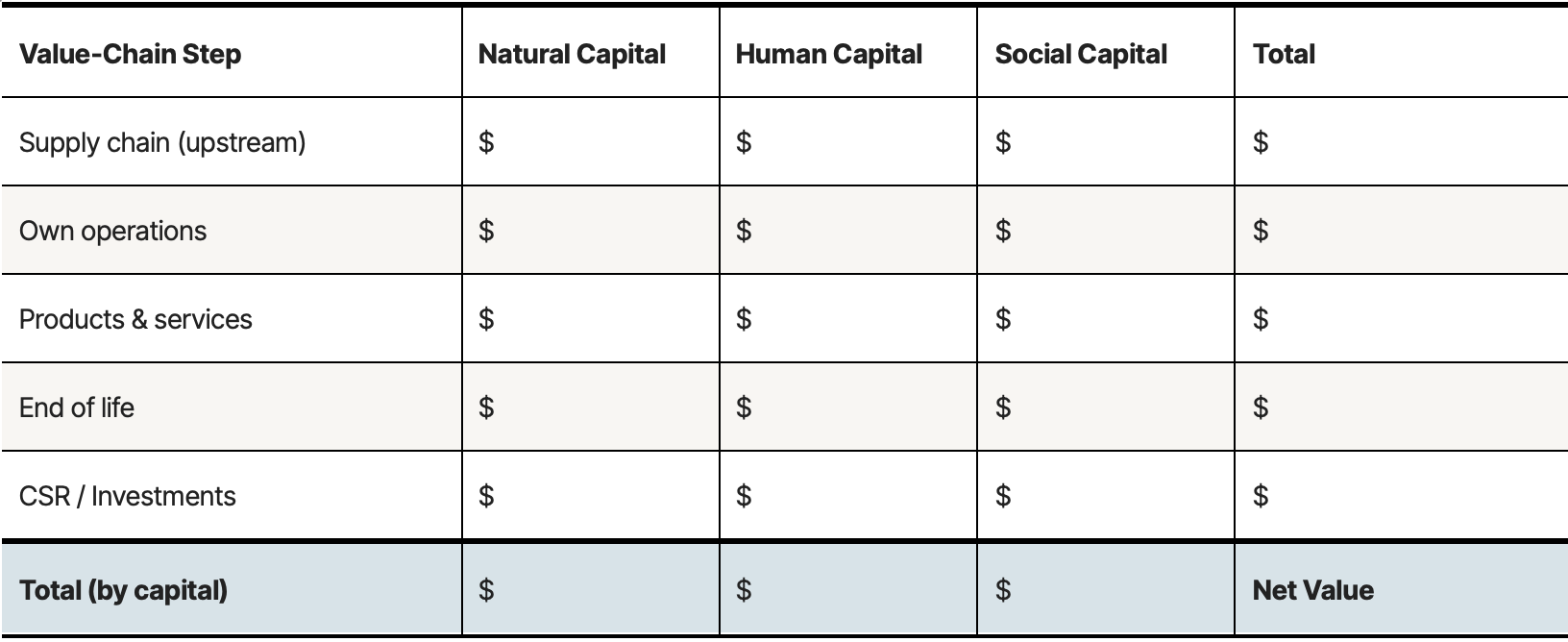
An Impact Statement — also known as an Integrated Profit & Loss (IP&L) — is an accounting framework that quantifies and values, in monetary terms, the positive and negative societal impacts of an organization over a defined period. It mirrors the structure of a financial P&L but applies a multi-capital lens, spanning natural, human, and social capital, across the full value chain: upstream supply chain, own operations, products and services, and end of life.
Unlike traditional ESG reporting, which tracks indicators in different units, the Impact Statement expresses all effects in a single comparable unit: monetary equivalents of societal value. This makes trade-offs visible, enables cross-topic prioritization, and provides decision-makers a clear picture of where the organization creates — or erodes — value for society.
The statement is organized as a matrix, with value-chain steps in rows and capital types in columns, producing a single-page overview with a net societal value for the period:
Table 1 — The Impact Statement recommended format. Positive values = net benefit to society; values in parentheses = net cost.
What does it cover?
The framework covers 27 impact indicators across three capital types. Natural capital (15 indicators) spans climate, pollution, land and ecosystems, and resources. Human capital (10 indicators) covers income and livelihoods, health and safety, equity and rights, and skills. Social capital (2 indicators) captures taxes and avoided costs to society. All 27 indicators are valued in a single monetary unit through the eQALY valuation method.
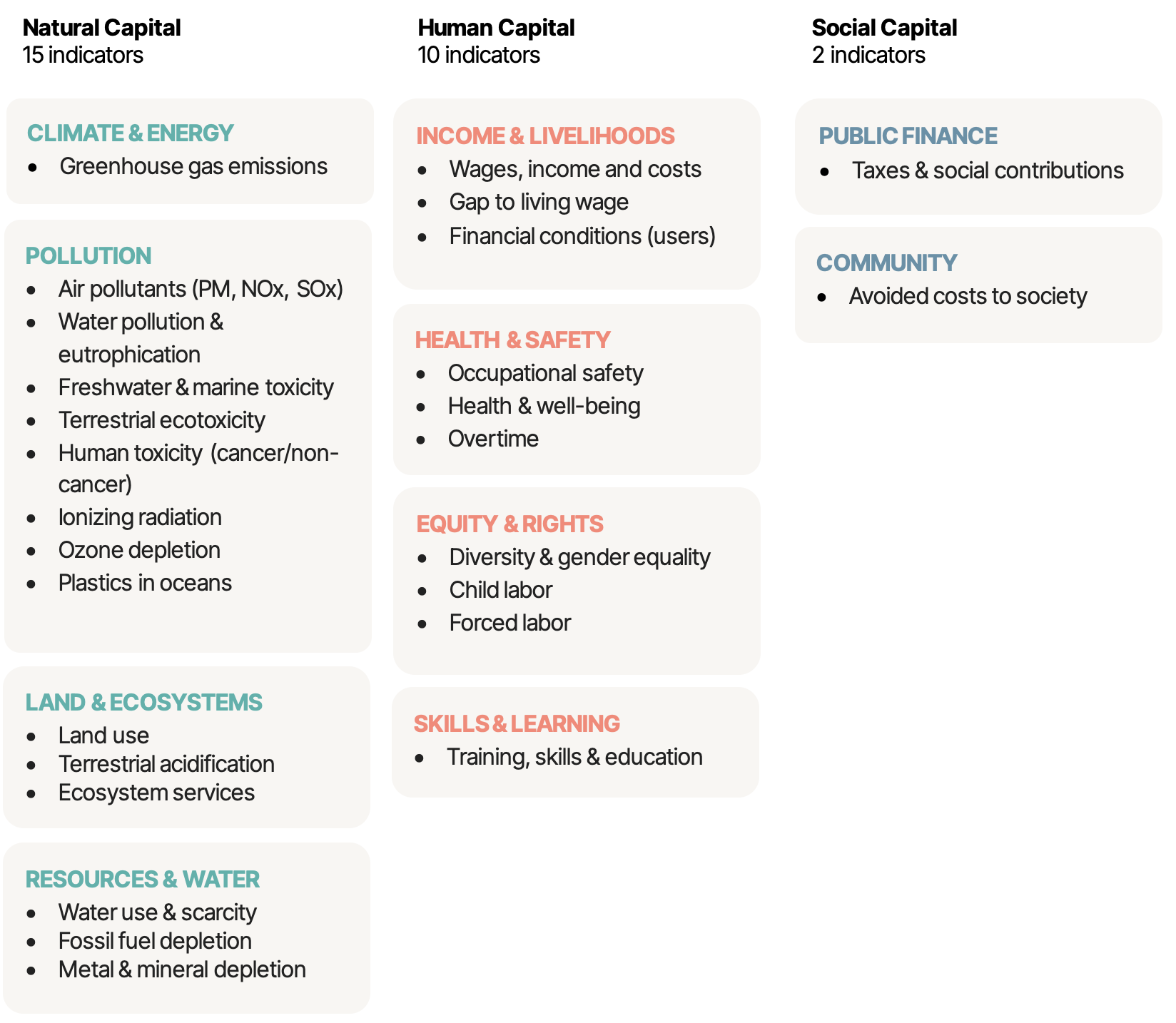
Figure 1 – 27 impact drivers mapped across the three capitals: natural, human and social capital.
The framework can be refined to align with an organization’s specific context — for example, by splitting the supply chain by material or supplier tier, or by segmenting products by customer group — while maintaining clean roll-ups and year-on-year comparability.
Where it fits and why it matters
Executives often ask how an Impact Statement relates to the tools they already use. The answer: it complements them. Financial P&Ls, ESG KPIs, LCA studies, and double materiality assessments each answer different questions at different levels of aggregation. The Impact Statement’s distinctive contribution is cross-topic comparability — it is the only instrument that translates unlike impacts into a single monetary unit, enabling ranking, netting, and trade-off analysis across capitals and value-chain steps.
Table 2 — Five performance measurement approaches compared. The Impact Statement row is highlighted.
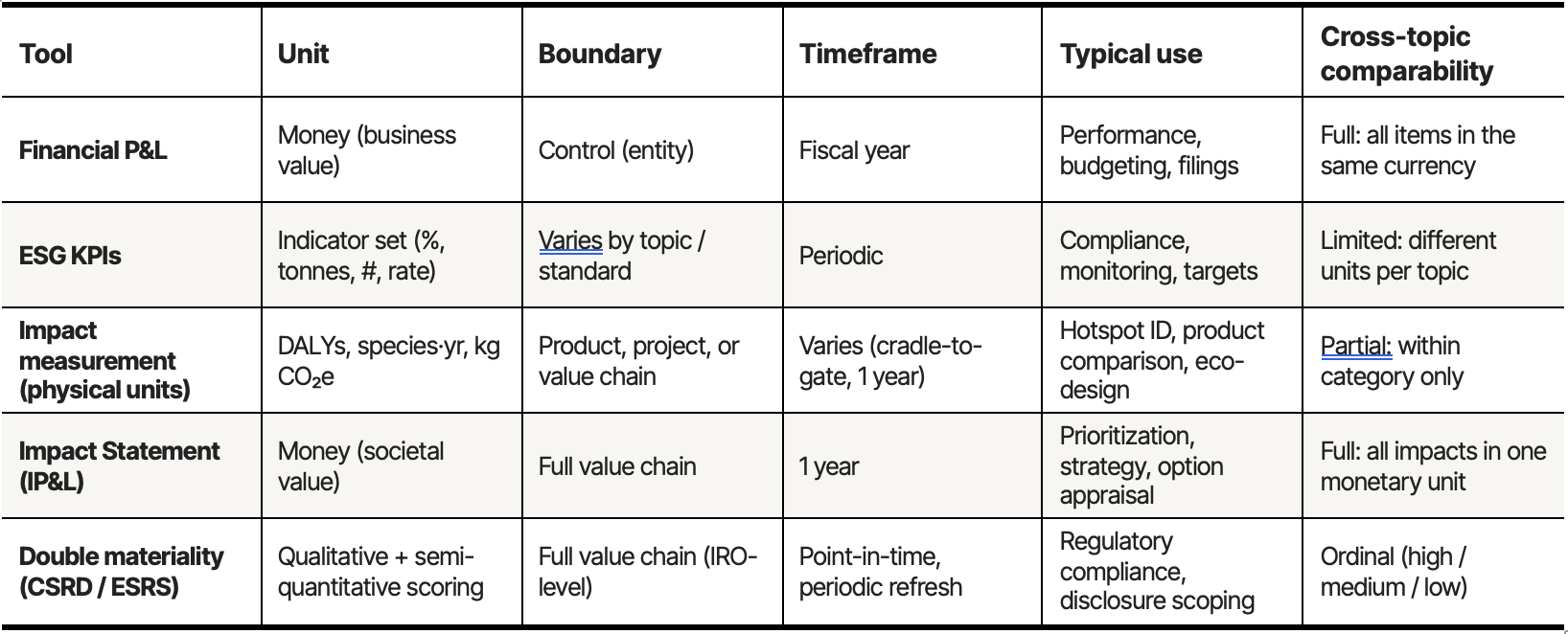
Leaders use the Impact Statement to reveal what matters most by ranking impact drivers by magnitude, make trade-offs explicit between capitals and value-chain steps, evaluate investments using societal return alongside financial returns, and strengthen stakeholder engagement with a transparent, monetized evidence base. For organizations already reporting under CSRD or conducting LCA studies, much of the analytical infrastructure is already in place — the marginal effort lies in applying the valuation layer and assembling results into the structured matrix.
How it works: the eQALY method
At the heart of the Impact Statement lies the eQALY (equivalent Quality-Adjusted Life Year) method, developed by Valuing Impact. The method translates fundamentally different kinds of impact — a tonne of CO₂ emitted, a wage gap closed, a workplace injury avoided — into a single, coherent measure of human well-being change, expressed in monetary terms.
Every line item follows one logical chain: Output × Outcome × Additionality × Value factor = Societal Value. Seven valuation pathways span the three capitals, each with its own calculation logic and regionalized value factors for 190+ countries.
The eQALY methodology paper and the latest global database of value factors and outcomes are all available for free and transparently.
Seeing it in action: Oda
To make the framework concrete, consider Oda, an online grocery platform assessed in collaboration with Summa Equity. The objective was to create a decision-ready Impact Statement covering the whole organization, its full value chain, all geographies, over a one-year period.
The assessment showed an overall net-positive societal value of approximately USD 523 million for the period. The most significant positive driver was product utility — the value customers derive from using the platform — at USD 473 million. Tax contributions across the supply chain and own operations added USD 105 million. Employment effects contributed another USD 12 million. On the negative side, the supply chain accounted for USD 68 million in natural capital costs, reflecting food production, packaging, and transportation — typical of food systems.
Table 3 – Oda Impact Statement across the value chain, capitals types and impact drivers
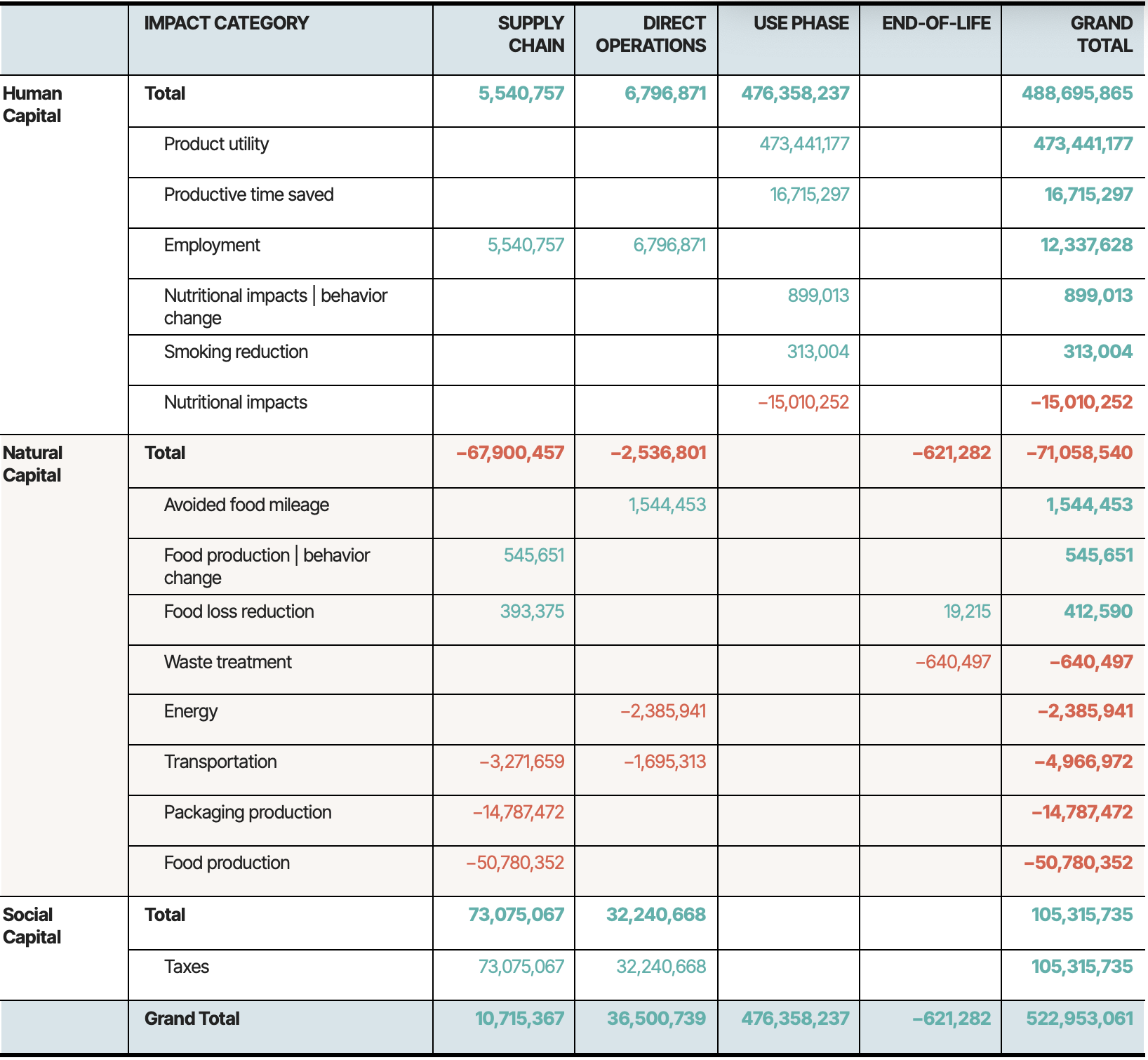
Beyond the numbers, the Impact Statement created a structured dialogue around trade-offs and leverage points. Based on the top drivers, leadership prioritized sustainable procurement in high-impact food categories, customer engagement through the digital platform to steer demand toward lower-impact choices, and targeted data improvements to reduce uncertainty on supplier practices. The one-page statement made it immediately clear where incremental effort would move the needle most.
From practice to standard
The Impact Statement framework is operational today. A first credible assessment can be produced in under a week with the eQALY method, the Excel template, and basic organizational data. Hundreds of organizations — from multinationals and investment funds to social enterprises — already use these approaches.
But the ambition goes beyond individual practice. By publishing this framework openly, we aim to contribute to the global standardization of impact accounting. The Capitals Coalition is advancing harmonized approaches to impact statements and has recently published its Governance for Valuation guidance, to which the eQALY method is aligned. The Impact Value Standards Board (IVSB) is building the architecture for globally accepted impact valuation standards. Valuing Impact is actively engaged with all three.
The field of impact valuation is at an inflection point. What was once a pioneering experiment is becoming an established discipline. The more organizations adopt rigorous, transparent, and comparable approaches, the faster the ecosystem matures — creating shared conventions, benchmarking data, and the institutional confidence needed for impact information to sit alongside financial reporting as a matter of course.
The full Impact Statement Framework report — covering scope, methodology, data collection, reporting format, case studies, and the complete eQALY appendix — is available for download on this page.