Download the dataset and methods
The download includes:
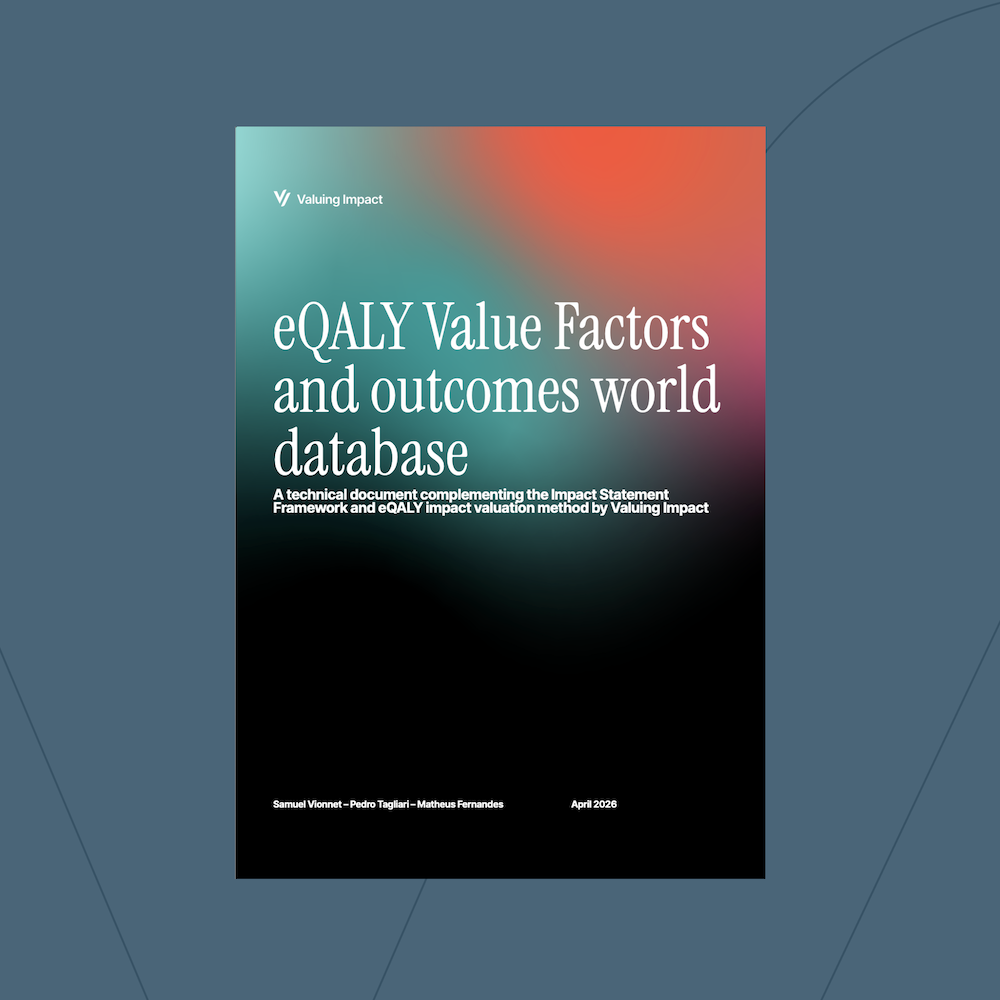
- The value factors and outcomes dataset and methodology report (v2.9, updated September 2026)
- The eQALY Impact Valuation Method
- Impact Statement Framework
A steering wheel for sustainability and impact strategy
Sustainability and impact have moved from compliance to strategy. Investors, executives, and policy-makers want to see where capital, products, and operations create or erode societal value, in numbers they can rank and compare. That requires data, and not generic ESG scores. It requires concrete value factors that convert each tonne of emissions, hour of labor, or dollar of wages into a measure of well-being change.
Done well, data-driven impact analysis becomes a powerful steering wheel for strategy. Done poorly, or not done at all, sustainability remains a reporting exercise. The data layer is what turns the wheel.
Valuing Impact has spent the last decade building that data layer. The eQALY method and its underlying value factors have been refined over hundreds of client engagements, from multinationals and investment funds to social enterprises and public agencies. The method is now one of the most widely used approaches for impact valuation worldwide, and is aligned with the Capitals Coalition’s Governance for Valuation guidance.
The 2026 release of the Value Factors & Outcomes Database collects that data layer into a single, publicly available dataset.
What the database covers
The database is a free, publicly available collection of value factors and outcome parameters for 266 countries, territories, and regions. Together, the five dataset families cover an estimated 99.9% of the data needs of any impact valuation analysis, across any kind of activity, and across the three capitals (human, social, and natural).
The Health Utility of Income (HUI) measures the well-being return on each dollar of personal income, expressed in DALYs per USD. It is derived from the country-specific link between income, life expectancy, and quality of life.
The Health Utility of Taxes (HUT) measures the well-being return on each dollar of tax revenue spent on public goods, on the same DALY-per-USD basis.
Natural capital value factors cover 18 environmental indicators based on the ReCiPe 2016 method, complemented by a marine plastics indicator.
The Living Wage dataset provides country-level living wages for all 266 countries and additional city-level resolution for 188 cities across 101 countries. The cost-of-living model is anchored in the Anker and Anker framework, with four explicit household scenarios.
The Outcome datasets are five companion datasets covering wages by skill level, education earning premium, personal income tax rates, job-creation baselines, and DALY per risk factor.
All value factors are denominated in USD (2025), anchored to a Social Value of Life of USD 62,082.
Measuring true societal value
A value factor has to express societal value in some unit. The choice of unit is not neutral. The database expresses every societal effect, whether environmental, economic, or social, in terms of changes in human well-being, measured through the equivalent Quality-Adjusted Life Year (eQALY).
This is a deliberate value choice. The view is that the true societal value of an activity is what it does for or against people’s lives, and well-being is the most direct measure of that. Economic costs, regulatory penalties, and willingness-to-pay are valid lenses for other questions, and Valuing Impact provides separate methods for them. Well-being as the unit allows direct comparison across very different kinds of impact, from climate change to fair wages to tax revenue.
Major changes since 2021
The 2026 release is a structural rebuild, not a refresh.
The HUI factor has moved from a pure life-expectancy gradient to a quality-adjusted measure that also captures the quality-of-life component of well-being. A new socio-demographic-index multiplier corrects for income-specific health pathways that the education gradient alone does not capture, including nutrition, housing quality, and healthcare access. Country coverage has doubled.
The HUT factor is rebuilt with a more transparent attribution and efficiency logic. An informal-employment adjustment captures the fact that taxes finance public goods even where the formal labor force is small. A Gulf-state correction is applied to economies where public services are funded mostly by resource rents rather than taxation.
Natural capital factors are based on the ReCiPe LCA method, regionalized for all countries in the world. Indicators such as particulate matter, eutrophication, water scarcity, and land use, are built on the best regionalized data and models. We added plastic leaking to oceans to the set.
The Living Wage dataset is rebuilt from the ground up. It now covers all 266 countries and regions, with additional city-level resolution for 188 cities across 101 countries, four explicit household scenarios (single individual, single parent, typical family, standard family), and a three-tier estimation hierarchy that flags where each country sits on the data-quality spectrum.
The Outcome datasets are new in this release. They package the most commonly requested outcome parameters into a consistent format that fits the eQALY method.
How the dataset integrates into the wider system
A value factor is most useful when it plugs into the rest of the valuation stack.
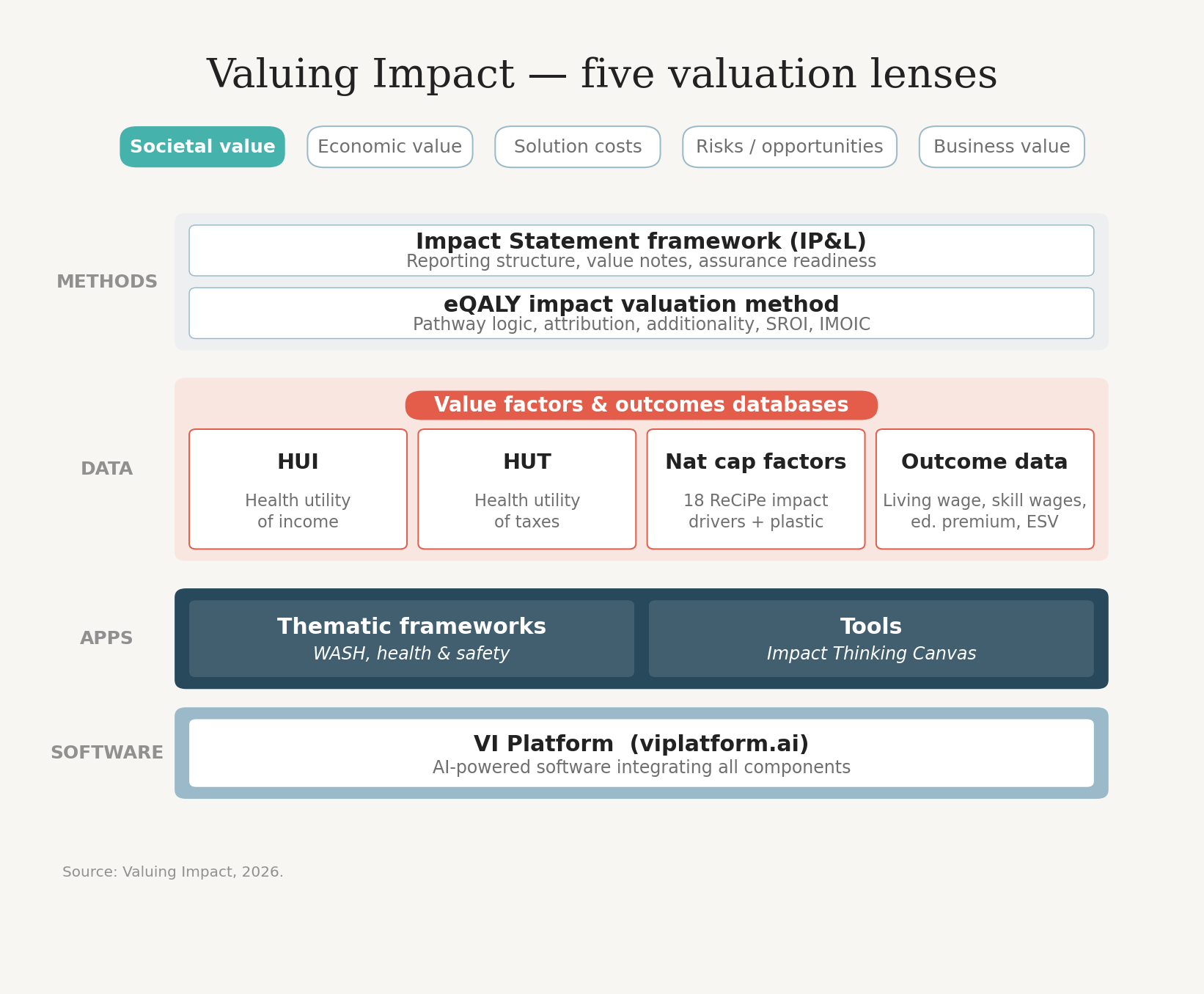
The database is the data layer of the Valuing Impact impact-valuation system. The methods sit above it. The eQALY impact valuation method handles line-item calculations, and the Impact Statement framework (IP&L) assembles those line items into a one-page societal P&L. Application tools sit alongside the methods, including thematic guides for WASH and health and safety, and the Impact Thinking Canvas.
Most organizations apply the dataset through one of two routes.
The first route is Excel, following the eQALY methodology guidance and the Impact Statement framework. Excel remains an excellent tool for impact valuation, and combined with general-purpose AI assistants, it now makes a credible impact valuation realistic for any organization without specialist software. The barrier used to be specialist knowledge of the methods. That barrier is much lower now.
The second route is impactaccounting.ai, Valuing Impact’s automated impact-accounting platform. The software wraps the same data and methods into a workflow that ingests organizational data and produces an Impact Statement directly. For organizations that want to integrate impact valuation into routine reporting rather than treat it as a one-off project, the platform removes most of the friction.
Both routes use the same underlying value factors. The difference is in the workflow.
Why the dataset is published openly
There is a commercial argument for keeping value factors proprietary. We have chosen not to make it.
Value factors used to inform investment decisions, regulatory disclosures, and corporate strategy should not be locked behind paywalls, membership fees, or consulting engagements. Open data is a precondition for replication, for peer review, for benchmarking, and eventually for standardization. The Capitals Coalition’s Governance for Valuation guidance, the work of the Impact Value Standards Board, and the broader convergence around impact accounting all depend on a baseline of openly available, well-documented inputs.
Publishing the database openly is also how trust gets built. The full methodology, data sources, vintages, and calculation steps are documented in the accompanying technical report. Users are free to interrogate the choices made along the way and adjust them for their own analysis.
What is next
The 2026 release continues a publication cadence that started in 2017, when the first Valuing Impact value factors were made public. Annual updates have followed each year as the science and data improve.
The wider ambition is to make impact valuation a routine part of how organizations and investors make decisions. That requires opening more than the value factors alone. The methodology behind the eQALY method and the Impact Statement framework from Valuing Impact, recently published, are the foundation to this building. Engagement with the Capitals Coalition, the Impact Value Standards Board, and the broader standards community runs in parallel, working to make impact information sit alongside financial reporting as a matter of course.
Feedback is welcome!
The complete Value Factors & Outcomes Database, including the methodology report and the full dataset in Excel, is available for download at the top of this page.