Download the whitepaper
Companies, investors and foundations spend more than ever measuring their social and environmental footprint, yet most of that information never reaches a decision. Our new paper, From measurement to decision, brings together nineteen impact valuation case studies, the largest collection published to date, and shows a field turning a corner. Across banks, consumer goods, private equity, family offices, sports federations and supply chains, impact valuation is moving out of the reporting annex and into the room where strategy, capital and operations are decided. The full paper is available for download below.
The question was never whether impact can be measured
A decade of methodological work has settled that debate. The eQALY method, well-being-anchored value factors and life-cycle data have made it possible to express what a business does to people and to nature in a unit that sits on the same page as the financial accounts. The harder question is what happens next. A number that no decision depends on is a cost. A number that changes which supplier is engaged, which initiative is funded or which market model is scaled is an asset.
That second category is what this paper documents. Nineteen client engagements, run between 2016 and 2026 across ten sectors, each anchored in a real decision. Some are named, including Genève Aéroport, Summa Equity, EA Technology, Grupo Boticário, Mercantil, Agrolimen, Tony’s Open Chain, Nelixia, Bracell, the FIVB Volleyball Foundation and Nestlé Waters at Buxton. Others appear anonymized at their request. All of them reviewed their case before publication.
It is worth saying what the paper is not. It is not a league table of who creates the most impact, and it does not pretend the numbers are more certain than they are. Where results rest on assumptions still being validated, the text says so. The cases were chosen because each one shows a decision actually changing, and that includes the unglamorous parts, such as first rounds that mostly built vocabulary, models revised downward after client challenge, and findings that contradicted what the organization expected to see.
Five kinds of decision, one common unit
The paper organizes the nineteen cases around five decision archetypes, because leaders do not ask “what is our impact” in the abstract. They ask what the organization should focus on (strategy), where capital should flow (investment), how performance should be managed against a mission (steering), how products and value chains should change (operations), and how to build trust with stakeholders (engagement).
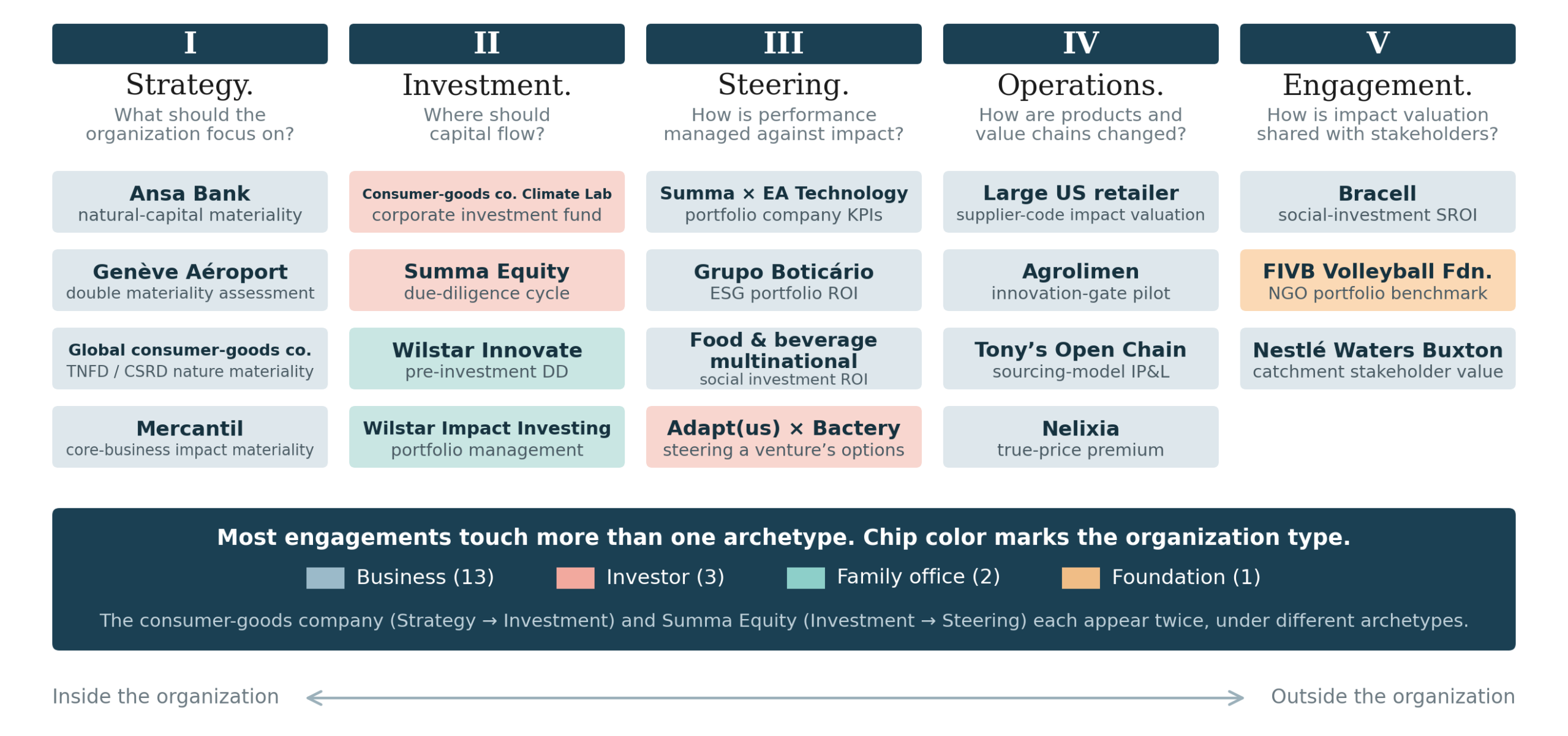
Each archetype gets its own part in the paper. Under strategy, materiality assessments at a Caribbean bank and a Swiss airport gain economic weight, a global consumer-goods company turns nature risk into a ranked list of interventions, and Mercantil values everything the bank does. Under investment, an internal climate fund, a private equity due-diligence cycle and a Norwegian family office show valuation deciding where money goes before it is committed. Under steering, EA Technology, Grupo Boticário, a Food & Beverage multinational and a venture builder use the same logic to keep performance honest against a mission. Under operations, a large US retailer, Agrolimen, Tony’s Open Chain and Nelixia bring it into sourcing, supplier and product decisions. And under engagement, Bracell, the FIVB Volleyball Foundation and Nestlé Waters at Buxton carry the unit outside the organization, to communities, federations and authorities.
Rankings flip, and that is the signal
Reading the cases side by side is where the patterns appear. The most consistent one is that rankings almost always flip when an existing priority list is re-expressed in a common unit, and the flip is the evidence that the unit is doing work. Mercantil found that roughly 94 percent of its societal value sits in the core lending and employment business, not in the social programs beside it, which reset where strategy, capital and communication go. The retailer’s supplier priorities reordered around where harm concentrates rather than where contract value sits. None of this means the earlier views were careless. It means money and attention had been allocated on a map that was missing a dimension.
A second pattern is that leaders decide on imperfect data when the unit is right, and refuse to decide on precise data expressed in the wrong currency. Most of the engagements ran on reasonable estimates, openly flagged, refined as the decision matured. At Buxton, the review in which the client challenged early assumptions and the model was revised down built more trust than a polished first draft would have. Waiting for perfect data turned out to be the expensive mistake.
From a one-off study to a capital-allocation discipline
The clearest sign that the field is maturing is what happens after the first report, when the valuation stops being a study and becomes part of how the organization runs. Grupo Boticário is a good example. The group had a substantial ESG portfolio delivering real outcomes at project level, but no language the finance function recognized. Valuing every initiative on a comparable return scale turned twenty-seven initiatives into a four-quadrant capital-allocation problem, with clear candidates to scale, to make more efficient, and to redesign or sunset.
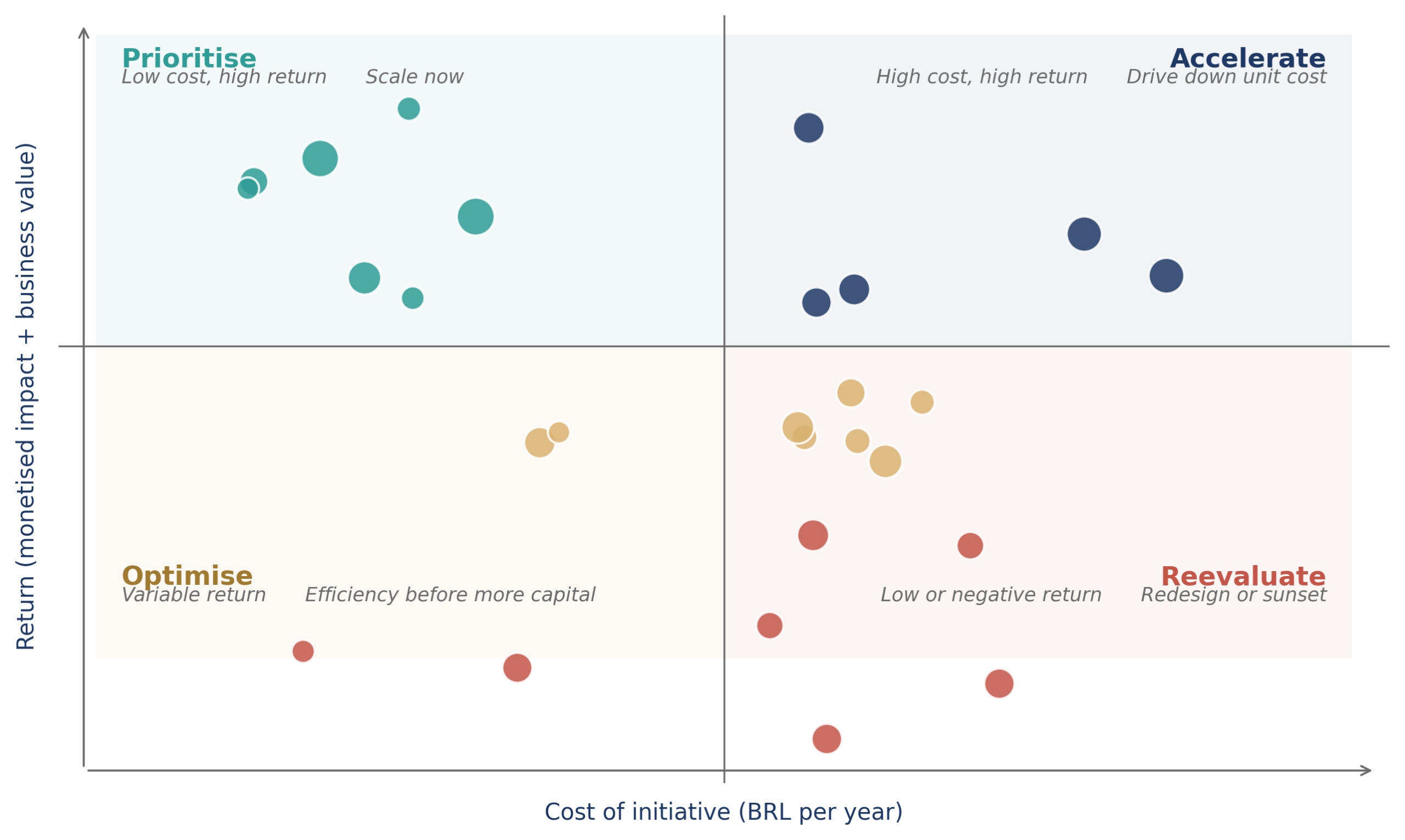
The operational consequence is the interesting part. New initiative proposals at Boticário now arrive with value levers projected at ideation stage, because the committee has a bar to hold them to. The same shift shows up elsewhere. EA Technology reports impact per pound of revenue to its shareholder Summa Equity alongside revenue and margin, with the latest annual update valuing every pound of revenue at 2.80 pounds of well-being benefit and 6.50 pounds of economic value, product by product. Tony’s Open Chain set its first integrated profit and loss statement against the cocoa sector it is built to replace, turning a sourcing philosophy into a measured difference. Nelixia documented that its regenerative cardamom creates 42 percent more societal value than conventional sourcing, which is what makes a true price defensible in front of customers.
The common thread is that impact valuation earns its place by shaping the choice, not by standing up as a public figure.
The translation is the real product
One more pattern deserves its own mention, because it surprised several of the organizations involved. In many engagements the most durable output was not the valuation itself but the shared language it created. Bracell uses the same SROI portfolio view to talk to communities and to its own board. The FIVB Volleyball Foundation’s delivery partners now fill in one questionnaire and read their results in one unit, so a partner in Kenya and a funder in Switzerland can discuss the same page. At Buxton, a peatland restoration that used to be reported as a single water figure is now read by a council, a regulator and residents in terms each already recognizes, around USD 3.3 million of societal value and a return of 2.7 dollars per dollar invested. Where stakeholders disagree about what matters, a common unit at least moves the conversation off first principles and onto magnitudes.
What this means if you are starting
The closing chapter translates the patterns into practical moves. Start from a decision already on the calendar, not from a methodology. Pick a first case that is visible, uncomfortable and close to senior leadership, because a safe pilot produces a careful report that no one uses. Work with the data you have and manage the uncertainty instead of chasing precision. And match the valuation lens to the decision on the table, because a supplier-prioritization question, a regulatory scenario and an investor conversation each need a different one. The Impact Valuation Lenses and the requirements for credible value factors described earlier on this blog are the backbone behind every case in the paper.
To get started on impact valuation, get the methodology documents on the eQALY impact valuation methodology, the Impact Statement Framework and the latest value factors published in 2026.
Our thanks go to the organizations and the people inside them who agreed to have their work described, reviewed every case for accuracy, and trusted that showing real decisions, including the imperfect ones, is more useful to the field than polished claims.
Get in touch to discuss what impact valuation could change in your own decision cycle.