Summary
Most investors know what their portfolio returns to them. Very few know what it returns to society. This paper proposes outcome investing, a simple way for any investor to set a goal for society next to a financial goal, to measure both in money, and to see which holdings do the work. It builds on the Total Portfolio Approach, which a growing number of large pension and sovereign funds use to judge every holding by what it adds to the whole portfolio rather than against a market index. The Total Portfolio Approach starts from objectives set for each client, which makes it a natural fit for portfolios built around sustainability goals. Outcome investing extends the idea from financial results and environmental, social and governance (ESG) scores to results for society, and from the impact of each company to the impact of the whole portfolio.
At the heart of outcome investing is a matrix built on two questions. Is a holding the kind of growth society needs? Is it changing in the right direction? The answers place each holding in one of four positions, namely: promote, transition, maintain or exclude. A break-even line shows how far each transition holding still has to go before it gives society more than it takes. Any investor can use the matrix, with a full impact valuation or with rough estimates.
The paper tests the matrix on a real pension portfolio of ten listed holdings, built by Duncan Pollard around post-growth principles. The portfolio meets its financial target and gives society slightly more than it takes, about 5,350 US dollars (USD) a year for every USD 1 million invested, or 0.5 per cent of its value. The holdings chosen to promote a wellbeing economy deliver clearly, while the holdings chosen for the transition carry most of the footprint and are not yet changing fast enough to make up for it.
The paper ends with six principles that investors and advisers can take away and repeat, and with an honest limit. One private portfolio of listed shares changes little on its own. Outcome investing will only matter if many investors take it up, which makes it a movement to build rather than a product to buy.
Part 1. Why outcome investing
Impact investing rests on a simple idea. Investors can want more from their money than a return and the protection of their wealth, and they can take some responsibility for what that money does to people and nature. The Global Impact Investing Network estimates that about USD 1.57 trillion is now managed as impact investments (Global Impact Investing Network, 2024), and far more carries a sustainability label. Even so, most private savers have no practical way to find out what their own portfolio returns to society.
Several routes are open to them, and each solves part of the problem (Table 1). Funds that follow ESG ratings are cheap and easy to buy, although the ratings mainly describe the risks a company faces rather than its effect on society. Different rating agencies also often disagree about the same company (Berg, Kölbel and Rigobon, 2022). Private equity and venture capital impact funds measure results more directly, but they remain largely closed to private savers. Regulators are starting to help. In the UK, for example, funds can now carry labels such as Sustainability Impact and Sustainability Improvers (Financial Conduct Authority, 2023). Labels help a saver choose a fund, yet they do not show what the whole portfolio returns to society.
Table 1. Routes to impact, and what each one misses for a private saver
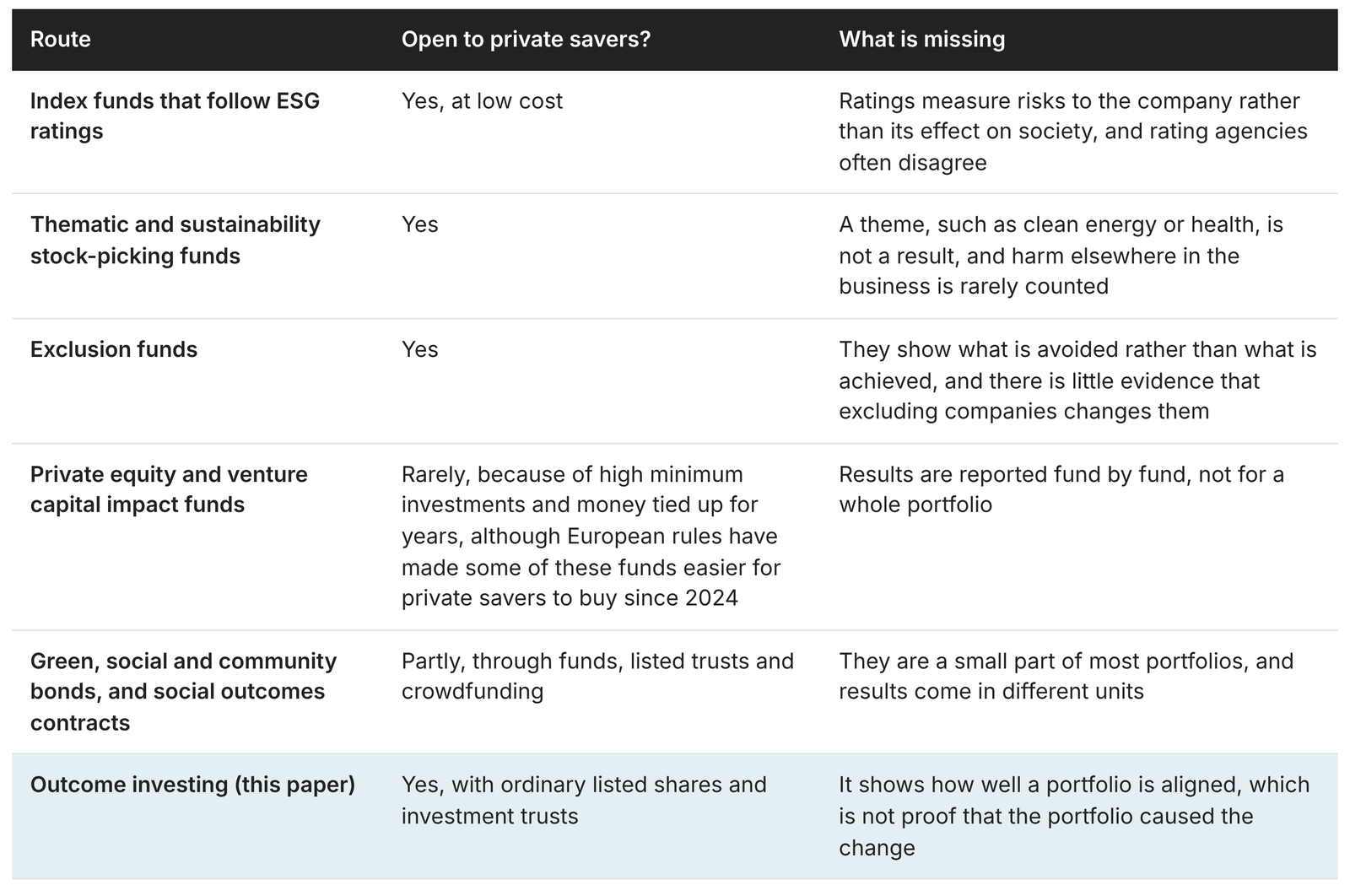
Sources: Berg, Kölbel and Rigobon (2022); Heeb and Kölbel (2020); European Union (2023).
The gap sits at the level of the whole portfolio. The Total Portfolio Approach asks the owner to judge each holding by what it adds to the whole (Chartered Alternative Investment Analyst Association, 2024). Recent guidance treats sustainability and real-world outcomes as part of the design (Urwin and Hayman, 2026), yet it does not offer a way to measure what a portfolio returns to society in the same money terms as its financial return. Impact investing measures results, but mostly one investment at a time and mostly in private markets. Private savers with ordinary portfolios of listed shares fall between the two.
Outcome investing is proposed to fill that gap. It keeps the discipline of the Total Portfolio Approach, meaning a financial target, a sustainability filter and a level of risk set by the owner rather than by an index. It then adds a second target, the net value the portfolio creates for society each year. The name is deliberate. In the Total Portfolio Approach, the outcome is the owner’s own goals in place of a market index. In outcomes-based finance, such as social outcomes contracts, investors are paid when a social result is achieved. Outcome investing borrows from both, and it uses impact valuation to put the result for society in the same unit as the financial one, in the spirit of impact-weighted accounts (Serafeim, Zochowski and Downing, 2019).
Part 2. The outcome investing matrix
Outcome investing asks two questions of every holding.
The first question is about growth. Is the business the kind of growth society needs? The answer is its value today, meaning the value it creates or destroys for people and nature in the ordinary course of what it does, from its supply chain to the use of its products. A solar farm or a social housing provider creates value today. A business with a heavy carbon or health footprint destroys it.
The second question is about transition. Is the business changing in the right direction, and fast enough to matter? The answer is the value of the change, meaning the extra value created by what the business is doing differently compared with business as usual, such as switching to renewable raw materials or to farming methods that restore soils. If the business is moving the wrong way, the value of the change is negative.
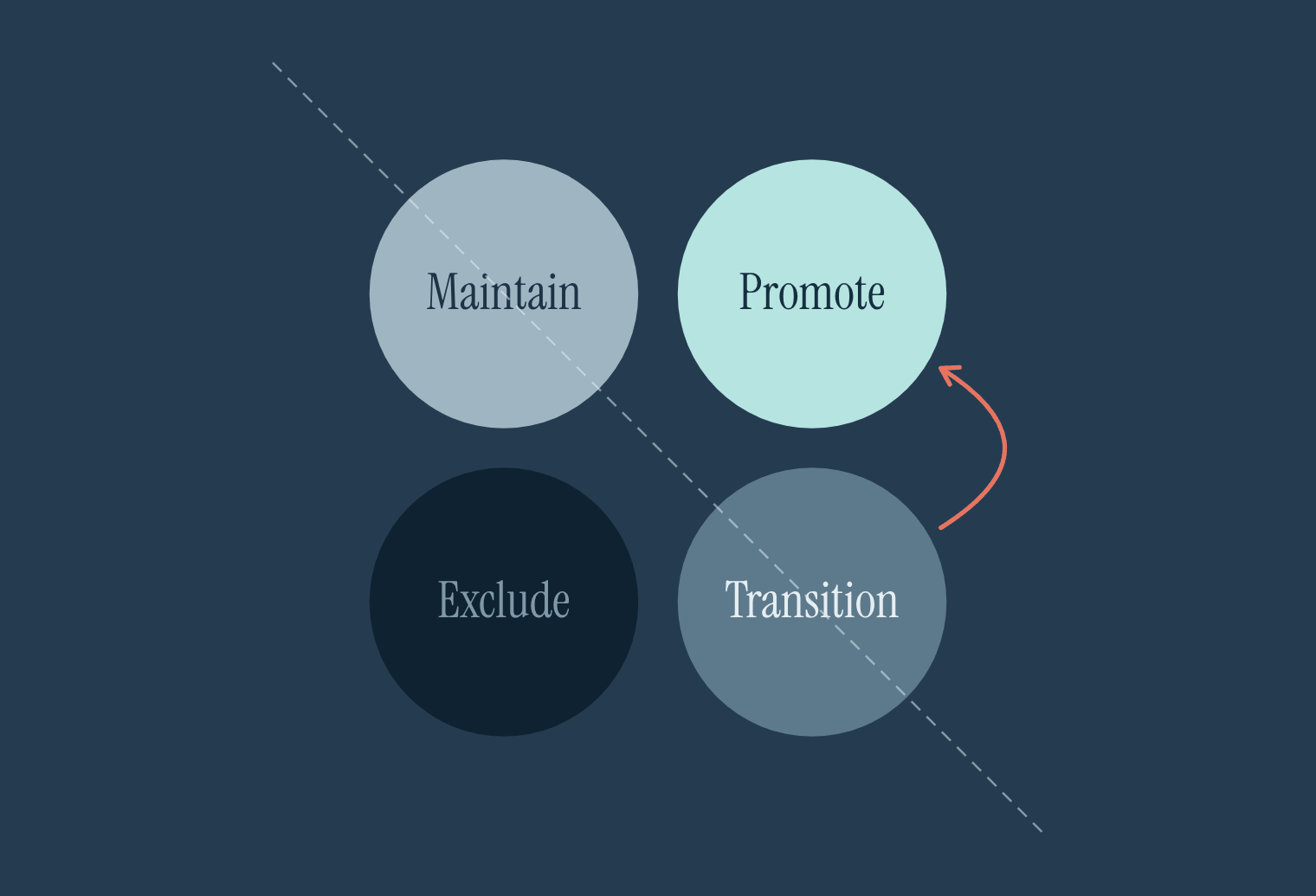
Both answers are expressed in money, per USD 1 million invested in the holding, each year. Placed against each other, they form a matrix with four positions (Figure 1).
- Promote. Good growth that is also improving. These holdings already give society more than they take. Hold them and add to them.
- Transition. A footprint today, with real change under way. These holdings belong in the portfolio only as long as the change continues and is big enough to matter.
- Maintain. Good growth that is not improving. Keep these holdings, and ask the companies for more.
- Exclude. Harmful and not improving. These holdings have no place in the portfolio.
The diagonal line adds a third idea. It is the break-even line, where the value of the change exactly offsets the value today. Above it, a holding gives society more than it takes. Below it, the change is not yet big enough to make up for the footprint. For a transition holding, the distance to the line is the gap it still has to close, and the direction of travel matters as much as the position. A good transition holding should move up and to the right over time, and in the end cross the line.
Figure 1. The outcome investing matrix
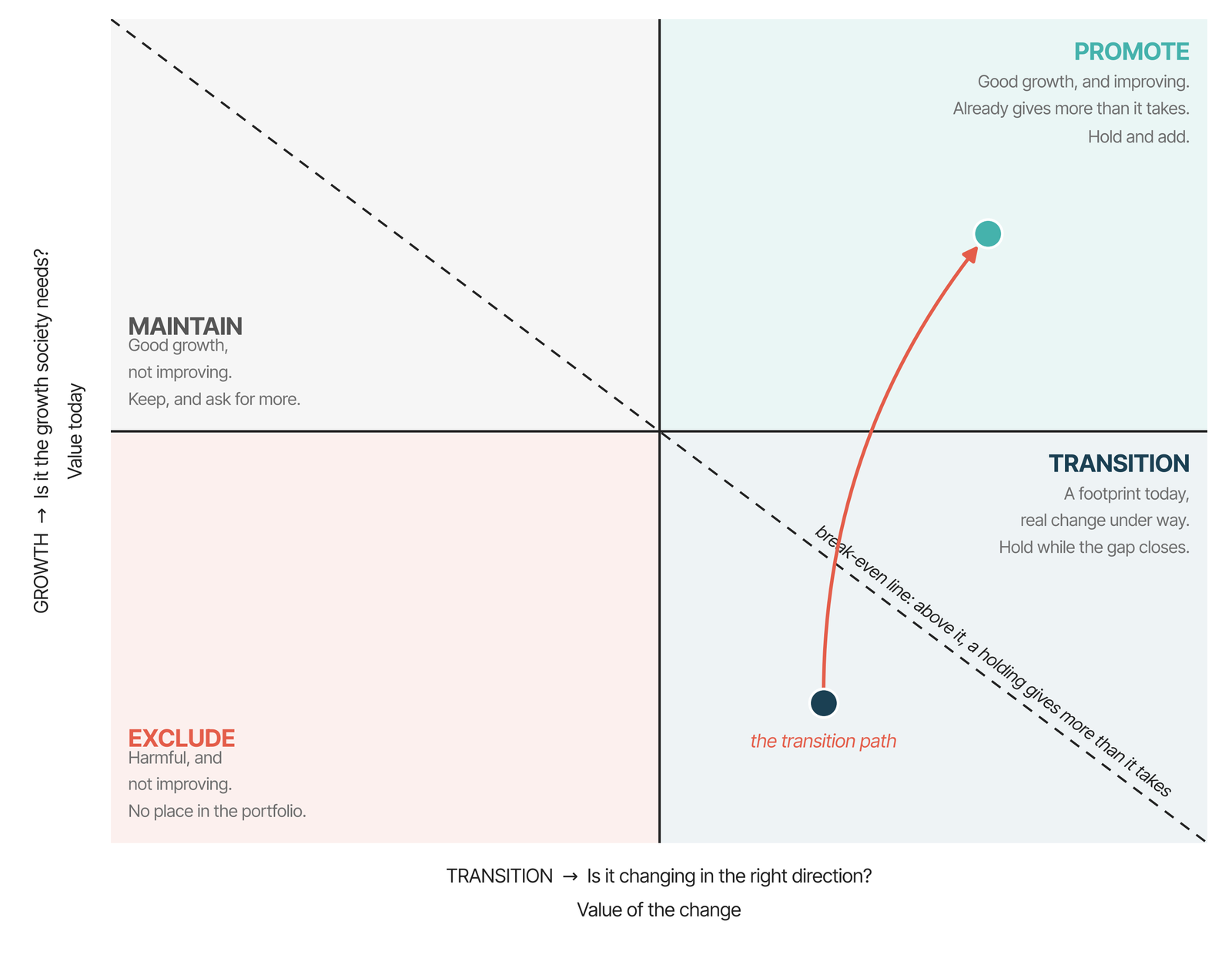
Each holding is placed by its value today, which answers the growth question, and by the value of the change, which answers the transition question. The dashed diagonal is the break-even line, where the two add up to zero. The arrow shows the path a transition holding should follow over time.
The matrix is meant to be used. An investor can place each holding with whatever data is available, from a full impact valuation to rough estimates, and ask three things of each one. Which position is it in? Which position should it be in? And what would move it there?
Part 3. The case study, a post-growth pension
This part is written by Duncan Pollard, who built the portfolio.
What post-growth means for a pension
Post-growth, the idea that we can deliver wellbeing within the limits of the planet by depending less on growth in gross domestic product, is gathering momentum (Kallis et al., 2025). Yet for many people the question is how post-growth fits with capitalism and with the way the financial sector works. What would a post-growth economy mean for an individual’s pension? Isn’t a share portfolio built on post-growth a contradiction?
There is a spectrum of ideas about what post-growth means. At one end is the degrowth of Kohei Saito’s Slow Down (Saito, 2024), a best-seller in its original Japanese edition, which builds on the later work of Marx to propose a “degrowth communism” with community and society at its centre. At the other end are wellbeing economics and doughnut economics, which work within the capitalist system. Steady-state economics and most mainstream ideas of post-growth sit in the middle. They accept that we still need growth in the sectors that deliver wellbeing, and in many countries and regions to raise living standards there. To be clear, this is not about “green growth”, for which there is no evidence that emissions and resource use can be separated from economic growth at the speed and scale needed (Haberl et al., 2020; Vogel and Hickel, 2023). Nor does a self-invested private pension deny the role of governments and democratic choices in building an economy based on fairness and wellbeing. Rather, in the absence of mainstream actions to transition to a post-growth world, this is an exercise in aligning my pension with my values, and my contribution to the debate.
A recent article by Noel Pacarro Brown in Investments & Wealth Review sets out a layered way to build a resilient portfolio on post-growth principles (Pacarro Brown, 2026). It starts from familiar design principles, such as preserving capital, generating steady cash flows and keeping flexibility, and adds two that are specific to post-growth, namely building resilience to the ways the economic system could break down and aligning the portfolio with evidence from the physical and social world.
My post-growth portfolio rests on three choices.
- promoting sectors and companies that contribute to a society delivering wellbeing for everyone;
- excluding sectors and companies that do not; and
- investing in companies that disrupt the old economy and drive the transition to a post-growth one.
The last choice needs explaining. As Antonio Gramsci wrote, “the crisis consists precisely in the fact that the old is dying and the new cannot be born” (Gramsci, 1971). It is not enough to choose companies already aligned with the future we want and to exclude the rest. Some investment also needs to go to companies that are actively building the new economy.
What goes in, and what stays out
Choosing sectors for the first group is fairly straightforward. Food, healthcare, housing, public transport and renewable energy are all core parts of a wellbeing economy, and all are likely to provide resilience. Within each theme only some companies fit a post-growth world, including some that raise capital for parts of the economy that mainstream markets underserve. For example, I invest in increasing the supply of social housing rather than in luxury or general housebuilders. Normal investing principles still apply, since a return is still needed and choices still have to be made. I have not yet found a suitable option for public transport, but I keep looking.
The transition group takes several forms. Some companies develop and sell products that reduce our dependence on fossil fuels. Others are finance firms focused on sustainability that challenge the traditional institutions. I also invest in smaller companies. Post-growth needs a rebalancing of power between communities, business and government. An economy dominated by multinational companies makes it harder for governments to set their own agenda. Smaller companies also cover the many other things that make a society harmonious and life enjoyable, so this part of the portfolio is spread broadly.
What stays out matters as much as what goes in. My exclusions are about aligning the portfolio with my values. I hold no fossil fuel or mining companies, and little in industrial or consumer discretionary companies. I hold far fewer large multinationals than the market does, and none of the so-called Magnificent 7, seven of the largest US technology companies.1 All of these can be seen as contributing to the risk of systemic collapse.
1 Large technology and data companies are excluded from the portfolio, although the portfolio assessment was carried out with the help of artificial intelligence. This is not a contradiction, since post-growth is a question of what we scale and who benefits rather than a rejection of tools.
The Center for Sustainable Finance and Private Wealth at the University of Zurich finds no evidence that excluding companies changes the world on its own, although making those choices public can feed public and political debate and, in time, change what companies do (Heeb and Kölbel, 2020). Hence this article.
Equally, the portfolio is not new money. I vote and engage with company boards directly, yet the portfolio is too small to change what companies do. A new pound invested in it funds nothing new and simply replaces another owner.
The financial result
I do not compare my financial performance with “the market”. The US S&P 500, the UK FTSE 100 and other share indices mean little to me. Instead, I set myself an absolute target return and a level of risk I am comfortable with, based on my living needs and inflation and taking account of both capital values and dividends, and I track performance against that target over a three-year moving average. On that measure the portfolio is doing its financial job. Over the last three years it has preserved its capital value whilst allowing me to take income in excess of currently available annuity values. Some will see a portfolio limited to a few sectors as risky, but only if it is measured against the market. Mine is not. I take a long-term view, and I am content with the sectors I have chosen.
The question that remained
The second result that matters to me is the portfolio’s effect on society and the environment, or, as Pacarro Brown puts it, its alignment with physical and social evidence. Only a few of my companies publish a decent impact report. Using the Implied Temperature Rise tool of the index provider MSCI, I estimate that the portfolio is consistent with warming of less than 2°C. Yet the question remained. Does a pension aligned with my values and the kind of growth the world needs actually deliver value to society? To find out, I turned to Valuing Impact and its Impact Statement Framework.
Part 4. Measuring the portfolio
Impact valuation measures, in money, the positive and negative effects of an organisation on people and nature across its whole value chain, from its suppliers to its own operations, the use of its products and their end of life. Valuing Impact’s Impact Statement Framework sets this out like a profit and loss account for society, covering effects on nature, on people and on communities (Valuing Impact, 2026a). It turns different effects such as emissions, wages and health into one common unit and then into money, so that they can be added up and compared. Valuing Impact has also described how such valuations are used to make decisions, drawing on nineteen engagements with businesses, investors, a foundation and a family office (Valuing Impact, 2026b).
A share portfolio adds a layer of complexity, because many holdings are funds whose own holdings keep changing. The post-growth portfolio holds ten positions, six investment trusts and four company shares (Table A1 in the appendix). Eight were valued in detail. The biotechnology trust and the smaller companies trust change their holdings too often to value each company they hold, so they were valued using industry averages. Artificial intelligence made the work much faster.
Each holding was measured twice, once for each question of the matrix. Value today captures what the business is responsible for in the ordinary course of what it does. Value of the change captures what the holding changes compared with business as usual, through the activity for which it was chosen. For the food company, that is its cuts in emissions and its sourcing from regenerative agriculture. For the chemicals company, it is its move from fossil to plant-based raw materials. All results are expressed per USD 1 million invested each year, for holdings at 31 December 2025, and they are initial figures.
The hardest questions were about food and chemicals. The hidden health, environmental and economic costs of the global food system are estimated at around twice what people spend on food (Hendriks et al., 2023). How much evidence of change justifies holding a food company? A chemicals company that serves consumer care, health and agriculture rather than plastics may fit a post-growth portfolio, especially if it is moving away from fossil raw materials. Yet are plant-based raw materials actually better for society? The valuation was designed to answer exactly these questions.
Part 5. What the results show
The portfolio gives back slightly more than it takes
For every USD 1 million invested, the portfolio creates net value for society of USD 5,347 a year, or 0.53 per cent of its value. How this result is built matters more than the total (Figure 2). The promote holdings create value today, and four times that amount through change. The transition holdings carry a large footprint, and the change they deliver makes up for only a quarter of it. Taken together, the eight holdings valued in detail come out at about zero. The positive total comes from the biotechnology trust, which was valued on industry averages.
One holding stands out. The pensions and insurance group, an asset manager that also provides workplace pensions, annuities and life insurance, is 12 per cent of the portfolio but accounts for 70 per cent of all its negative contributions. If its share were spread across the other holdings, the portfolio’s net value would rise to about 3 per cent of its value a year.
Figure 2. How the portfolio result is built
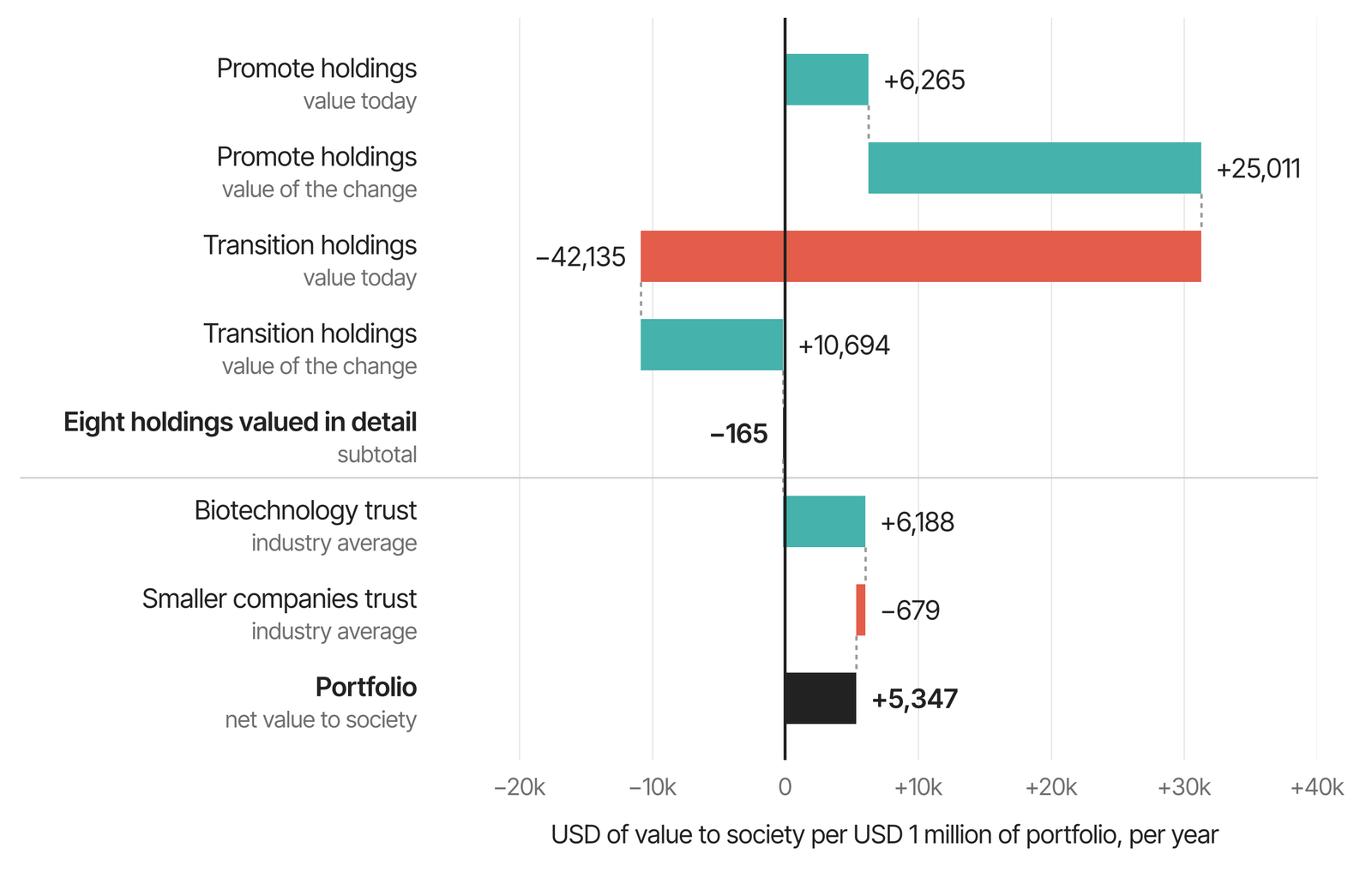
Contributions to the portfolio result, in USD of value to society per USD 1 million of portfolio, per year. Value today is what the businesses create or destroy in the ordinary course of business. Value of the change is what they change compared with business as usual. The biotechnology and smaller companies trusts were valued on industry averages, so their result is not split. Figures do not add exactly because of rounding. Source: Valuing Impact, holdings at 31 December 2025, initial figures.
The holdings land where the owner expected
Figure 3 places the eight holdings valued in detail on the outcome investing matrix. It uses their value per USD 1 million invested in each holding, so that a small trust and a large multinational can be compared on the same scale. All four promote holdings valued in detail sit in the promote corner. The solar fund and the social impact trust, which finances social housing and social enterprises, create the most value per dollar, mostly through change, while the sustainable asset manager creates the most value today. The food company, the chemicals company and the pensions and insurance group sit in the transition corner as intended, although all three are still below the break-even line. The private equity trust sits almost exactly at the centre, which means the valuation finds little effect either way, so its place in the portfolio rests on other grounds. No holding lands in the exclude corner, which is consistent with the owner’s exclusions.
Figure 3. The post-growth portfolio on the outcome investing matrix
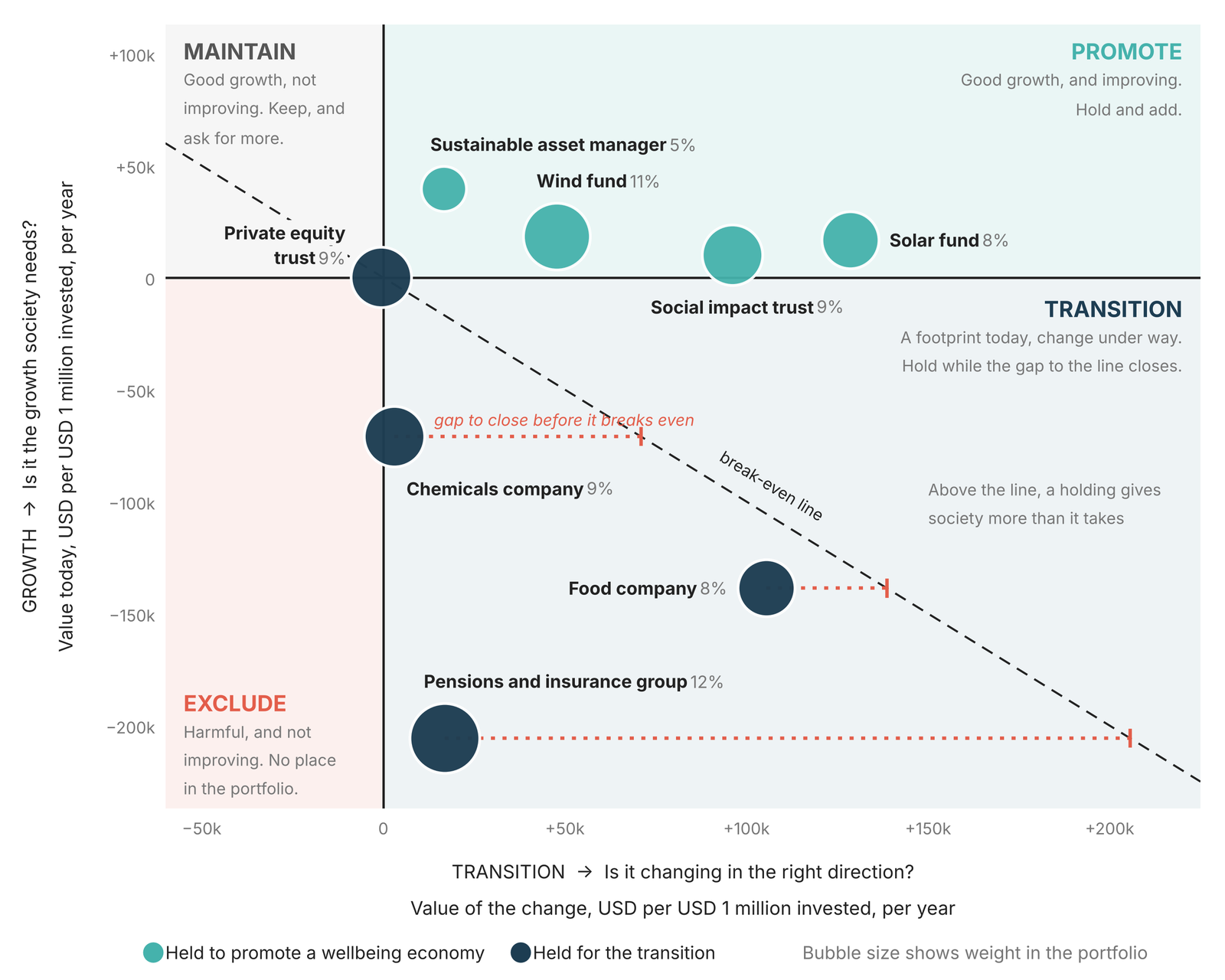
Eight holdings placed by value today and value of the change, in USD per USD 1 million invested in each holding, per year. Bubble size shows the weight in the portfolio. Dotted lines show the gap each transition holding still has to close to reach the break-even line. The biotechnology trust (19 per cent of the portfolio) and the smaller companies trust (10 per cent), valued on industry averages, cannot be placed. The chemicals company’s value of the change is provisional. Source: Valuing Impact, holdings at 31 December 2025, initial figures.
Where to act
The matrix also shows where to act. Of the three transition companies, the food company is closest to the line. Its change, from cutting emissions to sourcing from regenerative agriculture, is already the second largest in the portfolio per dollar invested, after the solar fund, and it needs about a third more to give back more than it takes. The chemicals company and the pensions and insurance group are much further away, each needing more than ten times their current change. For the chemicals company, the figure is provisional while the comparison between plant-based and fossil raw materials is checked. It is the only company in the portfolio with an explicit commitment to move away from fossil raw materials. For the pensions and insurance group, the gap is the main reason the portfolio is not more clearly positive. Most of it comes from the companies it invests in on behalf of its clients, so its voting and engagement with those companies matter far more than its own operations.
This is not an argument for selling the transition holdings, since they were chosen for what they are changing. Recent research suggests that pushing capital away from polluting companies can make them pollute more, while cheaper capital barely changes companies that are already green (Hartzmark and Shue, 2026). It is an argument for setting, for each transition holding, the evidence of change that would justify keeping it, checking it every year, and sharing the results with the companies and with like-minded investors. The chemicals company’s commitment, for example, deserves to be brought to other investors’ attention. The results also raise a simple rebalancing question. The biotechnology trust, at 19 per cent of the portfolio, delivers the least value per dollar of the promote holdings, although financially it offers the best growth prospects. The pensions and insurance group, for its part, pays one of the highest dividends in the portfolio.
For the owner, the portfolio also works as a personal balance sheet.
In the same way that I make consumer choices, buying organic or fair trade, or buying directly from farmers I know, I am trying to align my investments with my values. The numbers did not tell me that I had changed the world, but they did tell me which holdings do the work, which ones carry the footprint and where some rebalancing is needed.
Duncan Pollard
How the portfolio compares with the market
The obvious question is how this compares with simply owning the market, for example through a fund that tracks the S&P 500 or the FTSE All-Share. This paper does not put a number on that. Methods for valuing whole indices and funds vary, so setting an index figure next to the bottom-up, pathway-by-pathway valuation used for each holding here would compare methods more than portfolios.
The portfolio does, however, contain its own reference point. The pensions and insurance group manages money for millions of savers and holds shares in most listed companies through its index funds, which makes it the closest thing in the portfolio to owning the market. Its valuation counts the benefits that its pensions, annuities and insurance bring to customers, and it still lands far below the break-even line, because the footprint of the companies it invests in is much larger and is changing only slowly. Owning the market, seen this way, means owning useful products together with a large footprint.
If we use the pensions and insurance group as the reference point, the promote holdings sit well above that reference point, delivering what society needs and creating net value for society. But the inclusion of transition holdings means that the portfolio is not cleaner across the board. These holdings may be moving in the right direction, but they can only be said to mirror the market.
Part 6. Principles and limits
The case study shows that a private investor can build a portfolio around a goal for society, measure what it returns and see where to act, using listed shares and investment trusts that anyone can buy. The approach comes down to six principles.
Six principles of outcome investing
- Set two goals. Decide the return and level of risk the savings must deliver, how closely the portfolio should reflect personal values, and the outcome for society it should support. Judge both against these goals, not against a market index.
- Count the good and the bad together. Value the positive and negative effects of each holding in money, so they can be added up, compared and set beside the financial return.
- Ask two questions of every holding. Is it the growth society needs? Is it changing in the right direction, fast enough to matter?
- Give every holding a job. Place it on the matrix and decide whether to promote it, hold it through its transition, maintain it or exclude it.
- Make transition holdings earn their place. Decide in advance what evidence of change justifies holding them, check it every year, and sell if the gap to the break-even line stops closing.
- Claim little, and speak up. Owning a listed share rarely changes what a company does, so one portfolio should not claim its companies’ results as its own. What one investor can do is show the way. Publish the holdings, the method and the results, including the uncomfortable ones, and invite others to do the same. That is how a few portfolios become a movement.
What outcome investing cannot do alone
There is an important limit, and it applies to this portfolio as much as to any other. Research on investor impact separates what a company does from what an investor changes in that company (Kölbel et al., 2020). Buying a share on the stock market moves ownership from one investor to another, and the company carries on as before. In the terms used by Busch et al. (2021), such holdings are impact-aligned rather than impact-generating, as the owner of this portfolio acknowledges in Part 3.
Scale is what changes this. Socially conscious investors hold less than 2 per cent of US stock market wealth today, so when they sell a company’s shares, the cost to that company of raising money barely moves, by less than 0.01 percentage points, and a real effect would need them to hold more than 80 per cent of it (Berk and van Binsbergen, 2025). Experiments also show that investors will pay for impact but do not pay more for more of it (Heeb et al., 2023), which is a strong reason to measure impact rather than assume it. What an individual investor can do is engage with companies, put money where it is scarce, and send signals that change what other investors do.
So outcome investing is not a product that changes the world one portfolio at a time. It works as a movement. Social change tends to tip once a committed minority is large enough, and experiments on social norms put that point at around a quarter of a group (Centola et al., 2018). Moving money out of fossil fuels has itself been named as one of the social tipping points that could speed up the fall in emissions (Otto et al., 2020). A single pension will not get there. Thousands of savers, advisers and pension funds asking the same two questions, using the same matrix and publishing their results could, by changing what gets funded, what company boards are asked and what other investors see as normal.
That is the call to action of this paper. Set the two goals, measure the portfolio, place it on the matrix and publish the result. If enough investors do the same, outcome investing stops being one person’s experiment and becomes a way of investing.
Conclusion
Impact valuation turned a values-led pension portfolio into a measured one. It confirmed that the portfolio does its job for the owner, and gives society slightly more than it takes. It showed which holdings carry the footprint, and gave the owner a clear way to decide what to change. Outcome investing turns that experience into a simple framework. It extends the Total Portfolio Approach from what a portfolio returns to its owner to what it returns to society, and it eases one of the main practical limits of that approach, the lack of comparable data on outcomes, because each holding can now be valued from public information in the same money terms as its financial return. It also gives private investors a tool that until now has mostly been used by institutions. Its limits are real, and they are the reason it needs to spread.
References
Berg, F., Kölbel, J. F. and Rigobon, R. (2022). Aggregate Confusion: The Divergence of ESG Ratings. Review of Finance, 26(6), 1315–1344. https://doi.org/10.1093/rof/rfac033
Berk, J. B. and van Binsbergen, J. H. (2025). The impact of impact investing. Journal of Financial Economics, 164, 103972. https://doi.org/10.1016/j.jfineco.2024.103972
Busch, T., Bruce-Clark, P., Derwall, J., Eccles, R., Hebb, T., Hoepner, A., Klein, C., Krueger, P., Paetzold, F., Scholtens, B. and Weber, O. (2021). Impact investments: a call for (re)orientation. SN Business & Economics, 1(2), 33. https://doi.org/10.1007/s43546-020-00033-6
Centola, D., Becker, J., Brackbill, D. and Baronchelli, A. (2018). Experimental evidence for tipping points in social convention. Science, 360(6393), 1116–1119. https://doi.org/10.1126/science.aas8827
Chartered Alternative Investment Analyst (CAIA) Association (2024). Innovation Unleashed: The Rise of Total Portfolio Approach. https://caia.org/reports/innovation-unleashed-the-rise-of-total-portfolio-approach/
European Union (2023). Regulation (EU) 2023/606 of 15 March 2023 amending Regulation (EU) 2015/760 on European long-term investment funds. Official Journal of the European Union. https://eur-lex.europa.eu/eli/reg/2023/606/oj
Financial Conduct Authority (2023). PS23/16: Sustainability Disclosure Requirements and investment labels. https://www.fca.org.uk/publications/policy-statements/ps23-16-sustainability-disclosure-requirements-investment-labels
Global Impact Investing Network (2024). Sizing the Impact Investing Market 2024. https://thegiin.org/publication/research/sizing-the-impact-investing-market-2024/
Gramsci, A. (1971). Selections from the Prison Notebooks. Edited and translated by Q. Hoare and G. Nowell Smith. London: Lawrence and Wishart.
Haberl, H. et al. (2020). A systematic review of the evidence on decoupling of GDP, resource use and GHG emissions, part II: synthesizing the insights. Environmental Research Letters, 15(6), 065003. https://doi.org/10.1088/1748-9326/ab842a
Hartzmark, S. M. and Shue, K. (2026). Counterproductive Sustainable Investing: The Impact Elasticity of Brown and Green Firms. Working Paper 35519, National Bureau of Economic Research. https://www.nber.org/papers/w35519
Heeb, F. and Kölbel, J. (2020). The Investor’s Guide to Impact. Center for Sustainable Finance and Private Wealth, University of Zurich. https://www.cspglobal.org/research/publications/investors-guide-impact-how-can-investors-change-world
Heeb, F., Kölbel, J. F., Paetzold, F. and Zeisberger, S. (2023). Do Investors Care about Impact? Review of Financial Studies, 36(5), 1737–1787. https://doi.org/10.1093/rfs/hhac066
Hendriks, S. et al. (2023). The True Cost of Food: A Preliminary Assessment. In von Braun, J., Afsana, K., Fresco, L. O. and Hassan, M. H. A. (eds), Science and Innovations for Food Systems Transformation. Springer, 581–601. https://doi.org/10.1007/978-3-031-15703-5_32
Kallis, G., Hickel, J., O’Neill, D. W., Jackson, T., Victor, P. A., Raworth, K., Schor, J. B., Steinberger, J. K. and Ürge-Vorsatz, D. (2025). Post-growth: the science of wellbeing within planetary boundaries. The Lancet Planetary Health, 9(1), e62–e78. https://doi.org/10.1016/S2542-5196(24)00310-3
Kölbel, J. F., Heeb, F., Paetzold, F. and Busch, T. (2020). Can Sustainable Investing Save the World? Reviewing the Mechanisms of Investor Impact. Organization & Environment, 33(4), 554–574. https://doi.org/10.1177/1086026620919202
Otto, I. M. et al. (2020). Social tipping dynamics for stabilizing Earth’s climate by 2050. Proceedings of the National Academy of Sciences, 117(5), 2354–2365. https://doi.org/10.1073/pnas.1900577117
Pacarro Brown, N. (2026). The Post-Growth Perspective: A Client-Aware Framework for Resilient Portfolio Construction. Investments & Wealth Review, 41(3). https://publications.investmentsandwealth.org/iwpublications/library/item/vol__41__no__3__2026/4356420/
Saito, K. (2024). Slow Down: The Degrowth Manifesto. Translated by B. Bergstrom. New York: Astra House. https://www.penguinrandomhouse.com/books/734853/slow-down-by-kohei-saito/
Serafeim, G., Zochowski, T. R. and Downing, J. (2019). Impact-Weighted Financial Accounts: The Missing Piece for an Impact Economy. Harvard Business School White Paper. https://www.hbs.edu/faculty/Pages/item.aspx?num=59129
Urwin, R. and Hayman, G. (2026). The Total Portfolio Approach (TPA): A Practical Guide for Navigating the Transition to TPA. CFA Institute Research and Policy Center. https://doi.org/10.56227/26.1.20
Valuing Impact (2026a). Impact Statement Framework: Valuing, Accounting and Reporting Societal Impact, by S. Vionnet and P. Tagliari. https://valuingimpact.com/wp-content/uploads/2026/03/ValuingImpact_ImpactStatement_2026-03-02.pdf
Valuing Impact (2026b). From Measurement to Decision: How impact valuation is changing the way leaders decide. https://valuingimpact.com/wp-content/uploads/2026/06/VI_Impact-Valuation-Decision_Whitepaper_V21_FINAL.pdf
Vogel, J. and Hickel, J. (2023). Is green growth happening? An empirical analysis of achieved versus Paris-compliant CO2–GDP decoupling in high-income countries. The Lancet Planetary Health, 7(9), e759–e769. https://doi.org/10.1016/S2542-5196(23)00174-2
Appendix. Detailed results
Table A1. Results by holding
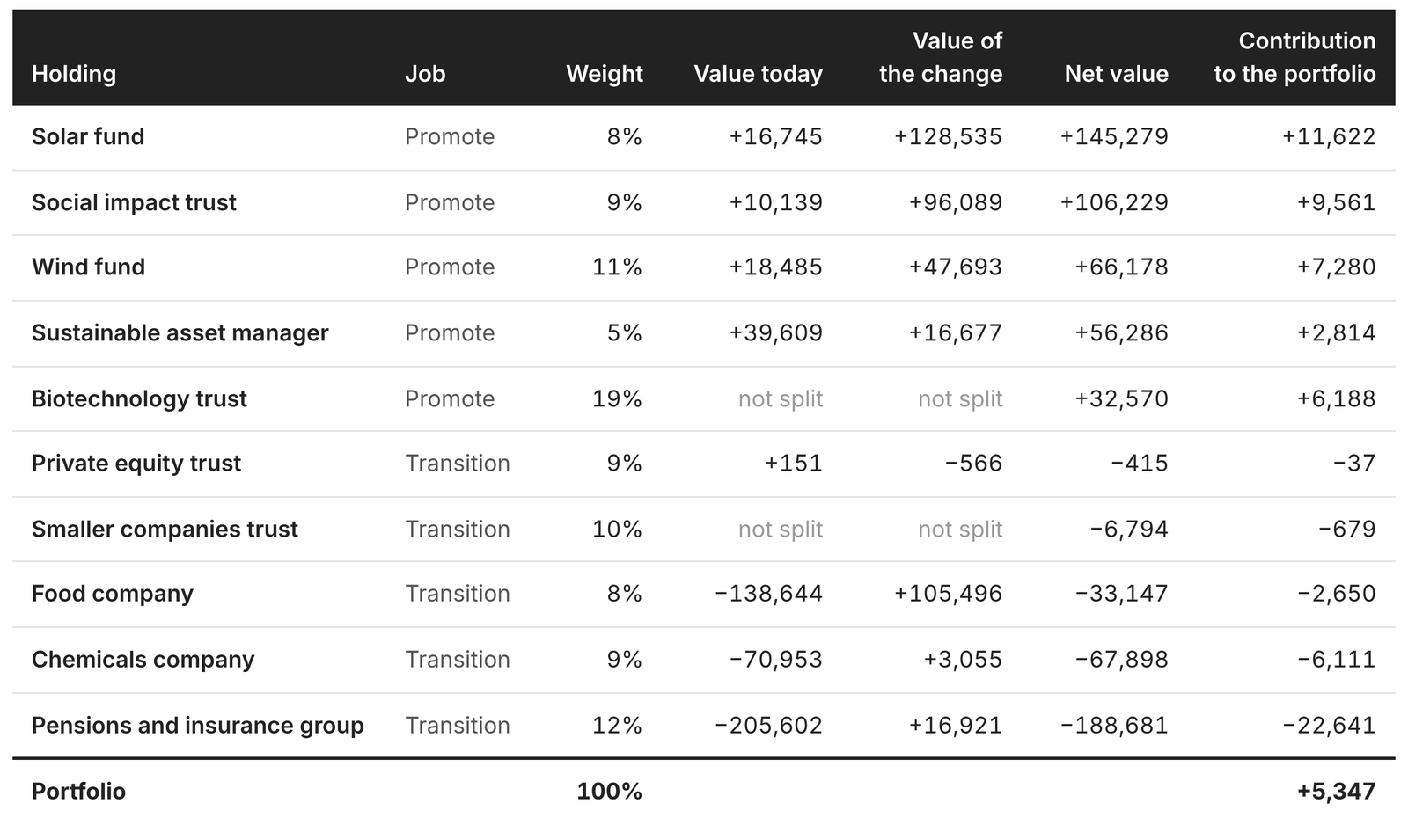
Value today, value of the change and net value are in USD per USD 1 million invested in the holding, per year. The contribution to the portfolio is in USD per USD 1 million of portfolio, per year, and the contributions add up to the portfolio result. Weights are the owner’s own. The two trusts marked not split were valued on industry averages. Value today and value of the change may differ from the net value by 1 because of rounding. The chemicals company’s value of the change is provisional. Source: Valuing Impact, holdings at 31 December 2025, initial figures.